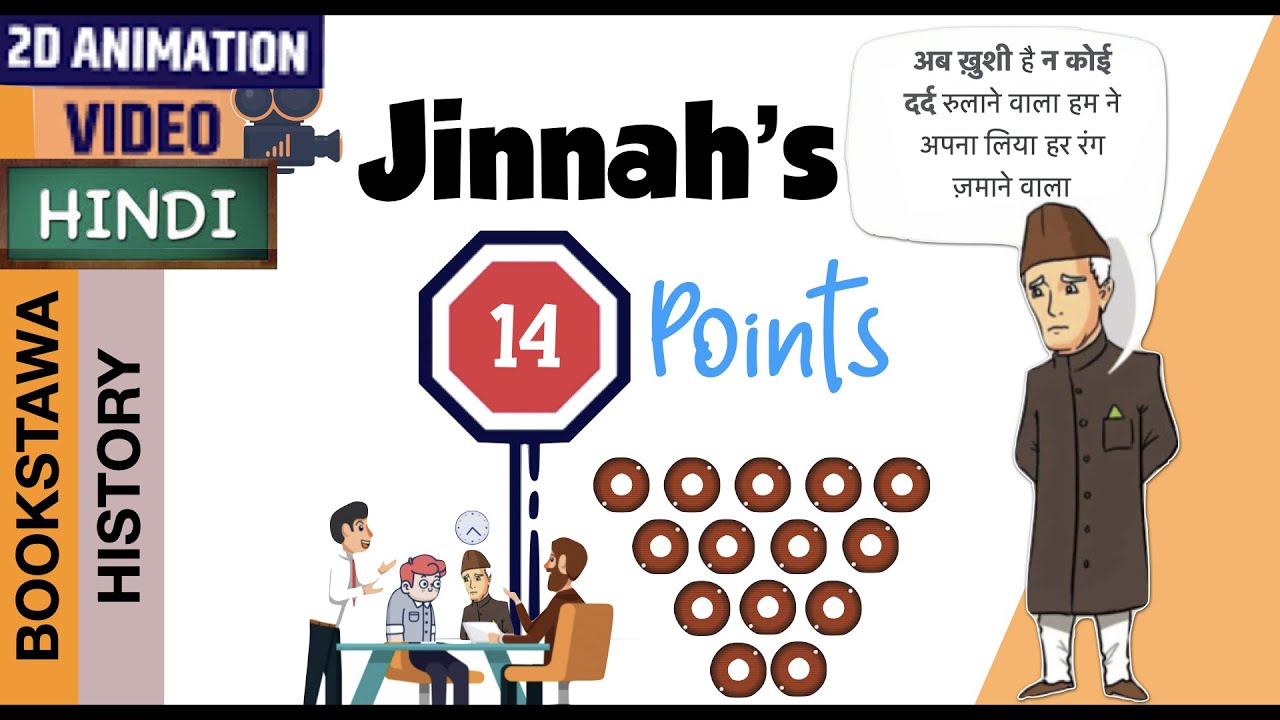
The Jinnah’s Amendments () and his subsequent Fourteen Points () marked a key turning point in relations between the Indian National Congress and the Muslim League. Driven by a need for Muslim safeguards and provincial autonomy, these constitutional demands became the League's main platform. They remain essential reading for students preparing for competitive exams on pre-independence Indian history.
🎯 In this chapter, you will understand:
- The historical background of the Nehru Report and Jinnah's proposed amendments.
- The core legislative modifications requested by Jinnah at the Calcutta All Parties Conference.
- The breakdown of demands into the official Fourteen Points of .
- The long-term impact of these events on Indian nationalist politics and future negotiations.
💡 Why this topic matters: It highlights the exact moment when political efforts shifted from joint Hindu-Muslim unity toward distinct minority safeguards, setting the path for India's constitutional journey.
🧠 Core Idea: Jinnah sought to balance national self-rule with legal protections for minority rights through federal power-sharing and provincial self-governance.
Jinnah’s Amendments (1928) and Fourteen Points (1929): The Struggle for Muslim Constitutional Safeguards
The political climate of was defined by strong efforts to draft a unified constitution, yet it revealed deep concerns about minority rights. As the independence movement tried to build a common platform against British rule, discussions over the Nehru Report tested Hindu-Muslim cooperation. These talks ultimately showed a growing divide in political visions.
- (i) The main background involved drafting the Nehru Report, which proposed self-governing dominion status but relied on shared voting districts (joint electorates), raising concerns within the Muslim League.
- (ii) Key events centered on the All Parties Conference, where political leaders debated how to balance majority rule with minority protections.
- (iii) This context is important because turning down these proposed changes ended the phase of shared unity efforts and started a more divided political dialogue.
Jinnah’s Amendments to the Nehru Report (1928): Seeking Legislative Balance
During the All Parties Conference in Calcutta in , Jinnah proposed specific changes to the Nehru Report to protect Muslim political rights.

The Context of the Calcutta Proposals
The Nehru Report had recommended dominion status and joint electorates, which Jinnah and other leaders felt lacked clear safeguards for Muslims.
- (i) The Muslim League viewed the Report as favoring majority rule without sufficient guarantees.
- (ii) Jinnah's proposals were a careful effort to reach a middle ground through legislative agreement.
- (iii) The amendments were seen as the basic guarantees needed for political harmony.
Specific Proposals for Legislative Amendments
The core of the proposals focused on making sure the Muslim minority kept an active voice in the new constitutional structure.
- (i) Representation: A request for one-third Muslim representation in the central legislature.
- (ii) Demographic Reservation: Reserved Muslim seats in Punjab and Bengal matching their exact population proportions.
- (iii) Power Distribution: Giving residual powers to individual provinces rather than the central government to ensure strong local decision-making.
The Rejection and Resulting Political Rift
The conference's refusal to accept these amendments caused a major shift in Indian political dynamics.
- (i) The conference turned down the amendments, creating disappointment within the League.
- (ii) This decision widened the divide between Congress and the Muslim League.
- (iii) It marked the end of Jinnah's reliance on joint nationalist negotiations.
Jinnah’s Fourteen Points (1929): The Official Charter of the Muslim League
By , after previous compromises were rejected, Jinnah organized his demands into the Fourteen Points, which became the official charter for the Muslim League.
Strategic Overview of the 1929 Document
These Fourteen Points offered a direct alternative to the Nehru Report, aiming to protect federalism and provincial autonomy.
- (i) The document set out clear baseline conditions for any future constitution.
- (ii) It focused on preserving Muslim identity within India's political system.
- (iii) The points helped bring different groups within the Muslim League together under one shared platform.
The Fourteen Points: A Comprehensive Narrative of Demands
The Fourteen Points presented a detailed outline for a federal India where minority rights and provincial governance were protected.
Constitutional Structure and Autonomy
- (a) A federal constitution where residual powers remain with the provinces.
- (b) Full self-governance and provincial autonomy for all regional units.
- (c) No constitutional changes by the central government without the clear agreement of the states.
Legislative and Executive Safeguards
- (a) Adequate Muslim representation in all lawmaking bodies and elected councils.
- (b) Fair selection of Muslims in public services and local governing bodies.
- (c) Guarantee of one-third Muslim representation in the central legislature.
- (d) Requirement that one-third of all ministers in central and state cabinets be Muslim.
Electoral Systems and Minority Protections
- (a) Keeping separate electorates as a key protection.
- (b) Rule that no law or resolution pass if three-fourths of a minority group opposes it.
- (c) Guaranteed religious freedom regarding belief, worship, and association for all citizens.
Territorial Adjustments and Cultural Preservation
- (a) Boundary changes must not reduce Muslim majorities in Punjab, Bengal, and the NWFP.
- (b) Separation of Sindh from the Bombay Presidency.
- (c) Introduction of constitutional reforms in the NWFP and Baluchistan.
- (d) Legal safeguards for Muslim culture, language, education, and religious practices.
Historical Evaluation: The Impact of the 1928-1929 Demands
The progression from Jinnah’s Amendments in to the Fourteen Points in marked a lasting shift in Indian politics.
The League’s New Political Trajectory
This period showed the Muslim League’s transition from joint negotiations to a distinct strategy focused on minority rights.
- (i) The Fourteen Points served as the baseline for the League in all future talks.
- (ii) It created a firm political stance that prioritized provincial autonomy to protect community interests.
- (iii) The lack of agreement at this stage contributed to the growing divide that later shaped political discussions across the subcontinent.
⚡ Quick Revision Capsule: Comparison of 1928 Amendments and 1929 Fourteen Points
The table below summarizes the key differences between the initial amendment requests and the full list of demands.
| Feature / Topic | Jinnah's Amendments () | Fourteen Points () |
|---|---|---|
| Primary Context | Response to draft Nehru Report at Calcutta | Standalone charter after rejection of amendments |
| Residual Powers | Vested in provinces | Vested in provinces with strict provincial autonomy |
| Central Representation | At least 1/3 seats for Muslims | 1/3 seats in central legislature and cabinets |
| Voting System | Modified joint electorates with reservations | Retention of separate electorates |
| Scope of Demands | Targeted legislative changes | Comprehensive coverage of culture, territories, and rights in NWFP & Sindh |
📝 Summary
In short, the movement from the amendments to the Fourteen Points highlights the widening gap between the major political groups. These events remain essential topics in Indian constitutional history, showing the ongoing struggle over Muslim safeguards and provincial autonomy. Understanding this transition provides valuable background on pre-independence governance discussions.
🚀 Quick Revision Points
Essential facts to review before examinations:
- (i) The Nehru Report () favored joint electorates without specific seat guarantees, prompting Jinnah's amendments.
- (ii) Jinnah requested one-third central legislative representation and population-based seats in Punjab and Bengal.
- (iii) The rejection of these changes led directly to the declaration of the Fourteen Points in .
- (iv) The Fourteen Points demanded separate electorates, cabinet representation, and the separation of Sindh from Bombay.
- 💡 Exam Tip: When answering exam questions, clearly distinguish between the Calcutta Amendments (focused on specific fixes to the Nehru Report) and the Fourteen Points (a full, standalone charter of demands).
❓ Frequently Asked Questions (FAQ)
Q1: Why did Jinnah propose amendments to the Nehru Report in 1928?
A1: Jinnah proposed changes because the Nehru Report relied on joint electorates without explicit seat reservations for minority populations in key provinces.Q2: What were the key demands regarding provincial autonomy?
A2: Both documents insisted that residual powers remain with individual provinces to prevent over-centralization of government authority.Q3: What was the main outcome of the rejection of Jinnah's 1928 proposals?
A3: The rejection ended joint constitutional efforts and prompted the Muslim League to adopt the Fourteen Points as their official bargaining position.