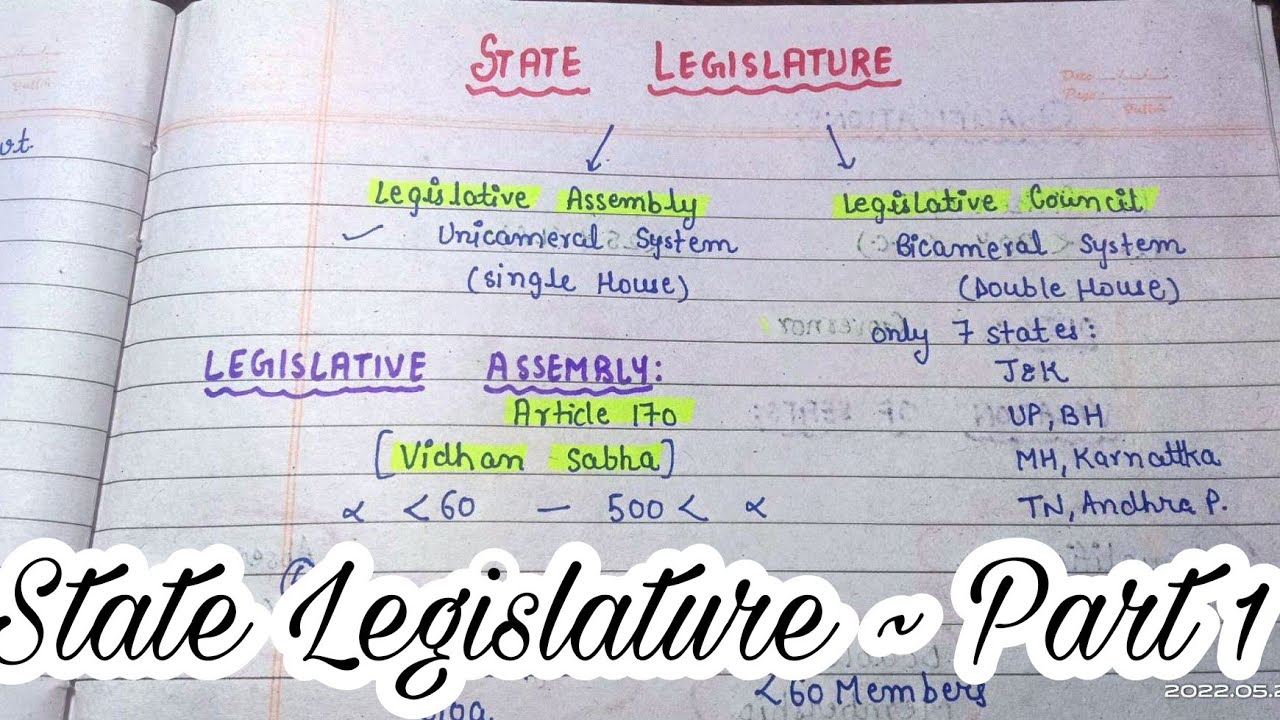
This comprehensive guide explains the State Legislature composition and the legal rules that govern Indian Polity. It helps students understand how laws are made at the state level, who can become a member of the legislature, and how members may lose their membership. Knowledge of the Representation of the People Act, 1951 and the Tenth Schedule is especially important for aspirants preparing for competitive examinations, because these laws explain how democratic governance works in Indian states.
🎯 In this chapter, you will understand:
- The structure of the State Legislature and the role of the Legislative Assembly and Legislative Council.
- How the strength, election, and nomination of Legislative Council members are decided.
- The duration, dissolution, and retirement rules of the Assembly and Council.
- The qualifications, disqualifications, and anti-defection rules for state legislators.
💡 Why this topic matters: The State Legislature makes laws for a state and keeps a check on the state government. To understand how democracy works beyond the national level, students must know how representatives are chosen, how long they remain in office, and what rules stop misuse of power.
🧠 Core Idea: The State Legislature balances direct public representation with careful review. The Legislative Assembly represents the direct choice of voters, while the Legislative Council provides a permanent and revisory chamber with members drawn from local bodies, graduates, teachers, legislators, and persons with special knowledge.
Constitutional Provisions of State Legislature Strength, Duration & Membership in
The architecture of the State Legislature is designed to balance direct representation with specialised deliberation. In simple words, one house directly represents the people who vote in elections, while the other house gives a second space for experienced members and experts to examine proposals. This system distinguishes between the lower house, called the Legislative Assembly, and the upper house, called the Legislative Council. It ensures that legislative power is exercised through a structured hierarchy of authority and electoral mandates rather than being concentrated in one chamber alone.
The Legislative Assembly is the primary body of direct democratic will because its members are chosen by voters. The Legislative Council serves as a revisory chamber, meaning it can review, discuss, and suggest changes to legislative work. Constitutional limits also prevent the upper house from overshadowing the directly elected representatives, thereby keeping the Assembly central to state governance.
- (i) The Legislative Assembly stands as the primary body of direct democratic will.
- (ii) The Legislative Council serves as a revisory chamber with unique selection criteria.
- (iii) Constitutional limits prevent the upper house from overshadowing the directly elected representatives.
Strength and Indirect Election of the Legislative Council
The upper house follows a distinct pattern of formation where members are not chosen by the general public in the same way as Assembly members. Instead, they are selected through a specialised college of electors. This means different groups—such as local representatives, graduates, teachers, and members of the Assembly—take part in choosing Council members. The purpose is to bring different kinds of experience and knowledge into the legislature, while still keeping the Council connected to the state’s democratic structure.
Numerical Limits and Legislative Dominance
In the narrative of state governance, the Legislative Council maintains a secondary but vital role. It is called secondary because it cannot replace the Assembly as the main elected chamber. However, it is vital because it gives the state an additional forum for discussion, review, and representation of special interests. To ensure the Legislative Assembly remains the dominant and directly elected chamber, the Constitution mandates specific size constraints.
- (i) The maximum size of the Council is strictly capped at one-third of the total strength of the Assembly.
- (ii) To maintain functional integrity, the minimum size is fixed at 40 members.
- (iii) While the Constitution sets these boundaries, the Parliament holds the final authority to determine the actual number of members for each state.
These limits are important because they stop the Council from becoming larger than the Assembly. If the Council were too large, it could weaken the authority of the directly elected house. By fixing a maximum limit and a minimum strength, the Constitution creates a balance: the Council must be big enough to function properly, but not so big that it challenges the Assembly’s democratic importance.
The Complex Manner of Election and Nominations
The composition of the Council is a mosaic of different social and political interests, ensuring indirect representation from various professional and local sectors. Instead of every member being elected by the general public, different groups choose different portions of the Council. This design allows local government representatives, educated graduates, teachers, legislators, and distinguished citizens to all have a place in the upper house.
- (i) One-third are elected by members of local bodies, including municipalities and district boards.
- (ii) One-twelfth are chosen by graduates who have held their degree for at least three years.
- (iii) One-twelfth are elected by teachers with three years of experience in secondary or higher institutions.
- (iv) One-third are elected by the Legislative Assembly members from outside their own ranks.
- (v) The final one-sixth are nominated by the Governor based on special knowledge in Art, Science, Literature, Cooperative Movement, or Social Service.
This mixture makes the Council different from the Assembly. Local body members represent grassroots governance, graduates and teachers represent educated and academic sections, Assembly members provide a legislative link, and the Governor’s nominees bring expertise in important fields. Together, these categories create a chamber that can look at public issues from more than one angle.
Procedural Nuances of Council Selection
The method of choosing Council members is not based only on simple majority voting. It uses a careful electoral system designed to make representation fair for different groups. This procedure ensures that smaller groups of electors can also have a meaningful voice in the result.
- (i) The election process utilises proportional representation through the single transferable vote system.
- (ii) Legal immunity: The Governor’s nomination is a discretionary power that cannot be challenged in a court of law.
Under proportional representation, seats are distributed in a way that reflects the strength of different groups of voters. The single transferable vote system allows a voter to mark preferences, and if a voter’s first choice cannot win or already has enough support, the vote can transfer to another preferred candidate. This makes the election process more representative than a simple first-past-the-post contest.
Duration and Continuity of the Two Houses
The two houses of the state legislature differ significantly in their lifespan, mirroring the relationship between the Lok Sabha and Rajya Sabha. The Assembly is temporary because it depends on the people’s mandate for a fixed period. The Council, however, is permanent because it is never dissolved as a whole; instead, its members retire in phases. This difference helps the state have both fresh public mandates and continuity in legislative experience.
Legislative Assembly: The Five-Year Cycle
The Assembly is a temporary body, existing as long as it holds the mandate of the people through a five-year term. Its life is linked to elections, which means the people get a regular opportunity to choose their representatives. This fixed term keeps the Assembly accountable to voters and allows the state government to be formed on the basis of a recent public mandate.
- (i) Its life begins from the date of its first sitting and ends automatically after five years.
- (ii) The Governor possesses the constitutional right to dissolve the house prematurely.
- (iii) During a National Emergency, its term can be extended by Parliament for one year at a time, though it must dissolve within six months of the emergency's end.
The five-year period is counted from the first sitting, not necessarily from the election day. This is an important detail because the Assembly becomes legally active when it first meets. The Governor’s power of dissolution means that the house can end before completing its full term, while the emergency provision allows Parliament to extend its life under exceptional national circumstances.
Legislative Council: A Permanent Chamber
The Council is characterised by its permanence, providing a stable legislative presence that does not disappear with elections. Unlike the Assembly, it is not dissolved after a fixed period. This permanence allows the Council to continue functioning even when Assembly elections take place, giving the state legislature continuity and institutional memory.
- (i) It is not subject to dissolution; instead, it follows a staggered retirement system.
- (ii) One-third of its members retire every second year, ensuring a continuous flow of new and experienced legislators.
- (iii) Each member enjoys a six-year term, with eligibility for re-election or re-nomination.
The staggered retirement system means that only one-third of the Council changes every two years. Therefore, at any given time, the Council contains both newer members and members who already have legislative experience. This design helps the house remain stable while still allowing regular opportunities for new representatives to enter.
Membership Qualifications and Disqualifications
Becoming a lawmaker requires meeting stringent constitutional standards and adhering to ethical legal frameworks. A person cannot simply enter the legislature without fulfilling conditions related to citizenship, age, oath, and electoral qualification. Similarly, a member may lose the seat if they violate legal rules, misuse public office, or act against the principles of political integrity. These rules help ensure that legislators remain responsible, qualified, and accountable to the public.
Constitutional Qualifications
To enter the legislature, a candidate must first prove their citizenship and age. These basic requirements ensure that the person has a legal and constitutional connection with India and is mature enough to take part in lawmaking. The candidate must also make a formal promise to uphold the unity and integrity of the country.
- (a) The individual must be a citizen of India.
- (b) An oath or affirmation must be taken, pledging sovereignty and integrity of India.
- (c) Age requirements: 25 years old for the Assembly and 30 years old for the Council.
- (d) Under the Representation of People Act, 1951, they must be an elector in the state and meet SC/ST requirements for reserved seats.
The higher age requirement for the Council reflects the idea that its members should bring greater maturity and experience. The requirement to be an elector in the state connects the candidate to the state’s electoral system. For seats reserved for Scheduled Castes or Scheduled Tribes, the candidate must belong to the relevant reserved category.
General and Statutory Disqualifications
A member can be removed or barred for various legal failures, including holding an office of profit or being of unsound mind. These disqualifications prevent conflicts of interest and protect the legislature from people who may not be legally fit to hold public office. They also discourage corruption, misuse of government resources, and participation in harmful social practices.
- (i) Conviction for any offence resulting in imprisonment for two or more years leads to immediate bar.
- (ii) Failure to lodge election expense accounts or having a financial interest in government contracts is a ground for removal.
- (iii) Practising social evils such as untouchability, dowry, or sati results in disqualification.
- (iv) The Governor makes the final decision on these matters, acting on the Election Commission’s advice.
An office of profit is a government position that may give a person financial benefit or influence. A legislator holding such an office could face a conflict between personal benefit and public duty. Similarly, failing to submit election expenses or having a financial stake in government contracts can create unfair advantage. The involvement of the Governor and the Election Commission ensures that disqualification decisions follow a legal process.
Disqualification on Grounds of Defection
To maintain political stability, the Tenth Schedule provides strict penalties for members who switch parties or defy leadership. This is commonly known as the anti-defection law. Its main purpose is to stop legislators from changing parties for personal gain and to protect the mandate given by voters to a political party.
- (i) The Speaker (Assembly) or Chairman (Council) serves as the deciding authority in defection cases.
- (ii) Per the Supreme Court (), these decisions are not absolute and are subject to judicial review.
When a defection question arises, the Speaker of the Legislative Assembly or the Chairman of the Legislative Council examines the case and decides whether disqualification should apply. However, this power is not completely beyond the courts. In Kihoto Hollohan v. Zachillhu (), the Supreme Court upheld judicial review, meaning courts can examine whether the Speaker’s or Chairman’s decision was legally valid. [390][392]
Summary of State Legislature Dynamics
Understanding the composition of state legislature and the Representation of the People Act, 1951 is essential for students to comprehend the checks and balances of Indian democracy. By defining the strength of the legislative council and the qualifications of members, the Constitution ensures that states are governed by qualified individuals under a permanent or representative house structure.
The State Legislature is not just a lawmaking body; it is a system of representation, review, accountability, and constitutional discipline. The Assembly gives direct expression to the voters’ choice, while the Council adds stability and specialised representation. Rules on tenure, qualification, disqualification, and defection ensure that elected representatives remain answerable to the Constitution and the people.
⚡ Quick Revision Capsule: State Legislature Composition and Membership
This table gathers the most examination-relevant facts about the State Legislature. It is useful for quick revision before tests, as it compares the Legislative Assembly and Legislative Council on strength, duration, membership, and disqualification.
| Aspect | Legislative Assembly | Legislative Council |
|---|---|---|
| Nature of House | Lower house and primary body of direct democratic will. | Upper house and revisory chamber with indirect representation. |
| Strength | Serves as the base for calculating the Council’s maximum strength. | Maximum: one-third of Assembly strength; minimum: 40 members; actual number decided by Parliament. |
| Mode of Formation | Directly elected representatives. | Local bodies, graduates, teachers, Assembly members, and Governor’s nominees. |
| Duration | Five years from the first sitting; may be dissolved earlier by the Governor. | Permanent house; not subject to dissolution. |
| Member Tenure | House lasts for a five-year term, subject to emergency extension and dissolution rules. | Six-year term; one-third members retire every second year. |
| Minimum Age | 25 years. | 30 years. |
| Defection Authority | Speaker decides defection cases. | Chairman decides defection cases. |
| Judicial Review | Applies to defection decisions under the Tenth Schedule. | Applies to Chairman’s decisions under the Tenth Schedule. |
📝 Summary
The State Legislature consists of the Legislative Assembly and, where it exists, the Legislative Council. The Assembly is the directly elected house with a normal five-year term beginning from its first sitting, while the Council is a permanent chamber whose members serve six-year terms and retire in phases. The Constitution limits the Council to a maximum of one-third of the Assembly’s strength and a minimum of 40 members. Its members are chosen through local bodies, graduates, teachers, Assembly members, and Governor’s nominees. The Representation of the People Act, 1951 and the Tenth Schedule provide important rules on eligibility, disqualification, and anti-defection, helping maintain responsible and stable democratic governance at the state level.
🚀 Quick Revision Points
Essential facts to review before examinations:
- (i) The Legislative Council’s maximum strength is one-third of the Assembly’s strength, and its minimum strength is 40 members.
- (ii) One-third Council members are elected by local bodies, one-third by Assembly members, and one-sixth are nominated by the Governor.
- (iii) The Assembly has a five-year term from its first sitting, while the Council is permanent and follows staggered retirement.
- (iv) Under the Tenth Schedule, the Speaker or Chairman decides defection cases, but the Supreme Court’s ruling makes such decisions subject to judicial review. [390]
- (v) The minimum age is 25 years for the Assembly and 30 years for the Council, as provided under the Representation of the People Act, 1951. [388]
- 💡 Exam Tip: Remember the Council’s composition as “3 + 1/12 + 1/12 + 3 + 1/6.” Here, one-third comes from local bodies, one-twelfth from graduates, one-twelfth from teachers, one-third from Assembly members, and one-sixth from Governor’s nominees. Also remember: Assembly—25 years; Council—30 years; Assembly—five-year term; Council—six-year member term.
❓ Frequently Asked Questions (FAQ)
Q1: Why is the Legislative Council called a permanent house?
A1: The Legislative Council is called permanent because it is never dissolved as a whole. Instead, one-third of its members retire every second year, and each member serves a six-year term. This creates continuity while still allowing new members to enter regularly.Q2: How are members of the Legislative Council chosen?
A2: Members are chosen through indirect representation. One-third are elected by local bodies, one-twelfth by graduates, one-twelfth by teachers, one-third by Assembly members, and one-sixth are nominated by the Governor for special knowledge in fields such as Art, Science, Literature, Cooperative Movement, or Social Service.Q3: Who decides disqualification under the anti-defection law?
A3: Under the Tenth Schedule, the Speaker decides defection cases in the Legislative Assembly, while the Chairman decides them in the Legislative Council. However, the Supreme Court held in that these decisions are subject to judicial review. [390][392]