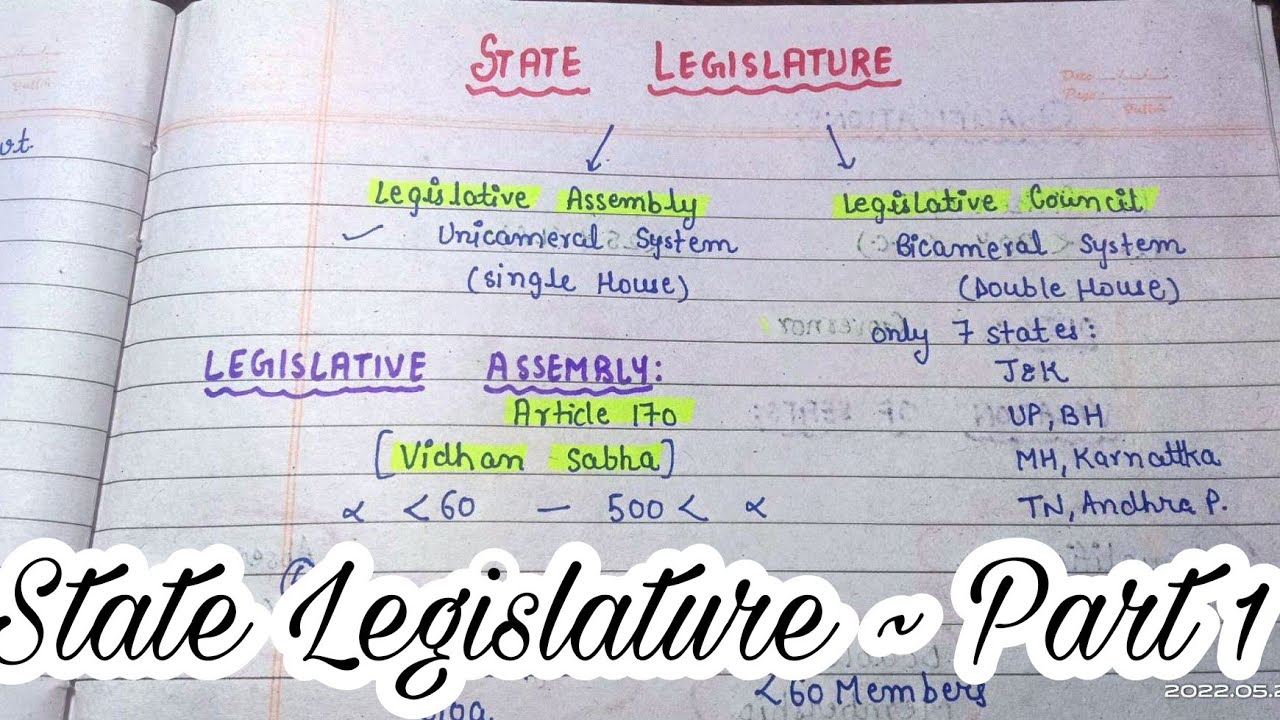
The State Legislature is the law-making body of an Indian state. It plays a central role in the political system of the Indian Union because it makes laws for the people of a state, discusses state problems, and keeps a check on the state government. Its working is explained in Articles 168 to 212 of Part VI of the Indian Constitution, which came into force on . These Articles explain how the State Legislature is organised, who can become its members, how long it lasts, who presides over its meetings, and what powers, procedures, and privileges it enjoys. For students and competitive-exam aspirants, this topic is important because it shows how democracy works not only at the national level through Parliament, but also at the state level through the Legislative Assembly and, in some states, the Legislative Council.
🎯 In this chapter, you will understand:
- The meaning and constitutional position of the State Legislature under Articles 168 to 212.
- The difference between unicameral and bicameral state legislatures.
- How a Legislative Council can be created or abolished.
- The composition of the Legislative Assembly and the reservation of seats for Scheduled Castes and Scheduled Tribes.
💡 Why this topic matters: The State Legislature connects the people of a state with the process of law-making. It helps students understand how state governments are formed, how elected representatives make laws, and how the Constitution balances local needs with national unity.
🧠 Core Idea: Every state has a Legislature consisting of the Governor and one House, the Legislative Assembly. Some states also have a second House, the Legislative Council. The Constitution allows states to have different structures according to their needs.
State Legislature in the Indian Constitution: Organization and Structural Evolution
The State Legislature is the primary legislative body within a state. In simple words, it is the group of representatives that makes, changes, or removes laws for that state. Just as Parliament makes laws for the whole country, the State Legislature makes laws mainly for matters that concern a particular state. It is therefore a cornerstone of provincial governance and an important part of India’s federal structure.
The working of the State Legislature is governed by the high standards laid down in the Indian Constitution. The Constitution does not leave the working of state legislatures unclear or uncertain. Instead, it gives detailed rules so that democratic stability can be maintained at the regional level. These rules ensure that representatives are chosen properly, meetings are conducted in an organised manner, and the rights of members are protected.
The foundational rules relating to the State Legislature are contained in Articles 168 to 212, located in Part VI of the Indian Constitution. This part is titled “The States” and deals with the government and administration of states.
- (i) These constitutional provisions comprehensively cover the organisation, composition, duration, and presiding officers of the houses. Organisation means how the legislature is arranged; composition means who its members are; duration means how long it continues; and presiding officers are the persons who conduct its meetings.
- (ii) The Articles also explain the specific powers, procedures, and privileges of the State Legislature. Powers allow it to make laws and control the state executive; procedures explain the method of conducting business; and privileges protect members while they perform their legislative duties.
- (iii) In many respects, the State Legislature mirrors the Parliament. For example, both have rules for law-making, debates, committees, and privileges. However, the State Legislature also has distinct local characteristics because it deals with the needs, resources, population, and administration of an individual state.
Organisation of the State Legislature and Systemic Variations
The structural design of the State Legislature in India is not the same in every state. The Constitution allows diversity because different states have different populations, administrative needs, financial capacity, and political histories. A small state may not require two legislative houses, while a large state may feel the need for an additional House to review legislation and represent different sections of society.
According to Article 168, every state must have a Legislature. This Legislature always includes the Governor. The Governor is not an elected member of the Legislature, but he or she is a constitutional part of it because bills passed by the state legislature require the Governor’s assent to become law. The remaining part of the Legislature consists of one or two Houses.

Understanding Unicameral and Bicameral Systems
The constitutional framework allows two distinct patterns of legislative organisation: the unicameral system and the bicameral system. These terms describe the number of legislative Houses in a state. The word “uni” means one, while “bi” means two. Therefore, a unicameral legislature has one legislative House, and a bicameral legislature has two legislative Houses.
- (i) In a unicameral system, the Legislature consists of the Governor and the Legislative Assembly, also called the Vidhan Sabha. The Assembly is the directly elected House, so it represents the people of the state. According to the raw content, 22 states follow this model.
- (ii) In a bicameral system, the structure is expanded to include the Governor, the Legislative Assembly, and the Legislative Council, also called the Vidhan Parishad. Here, the Assembly is the Lower House and the Council is the Upper House.
- (iii) As of , seven states—Andhra Pradesh, Telangana, Uttar Pradesh, Bihar, Maharashtra, Karnataka, and Jammu & Kashmir—were identified as having bicameral legislatures.
- (iv) Historical anomalies also exist. For example, the 7th Constitutional Amendment Act, 1956 permitted a Legislative Council in Madhya Pradesh. However, because the President never issued the necessary notification, Madhya Pradesh remained unicameral.
The Legal Process for the Abolition and Creation of Legislative Councils
The Indian Constitution provides a flexible mechanism for states to decide whether they require a second chamber. A state may want a Legislative Council to provide experienced members, represent special interests, or review bills carefully. On the other hand, a state may feel that a second House increases expenditure or delays law-making. Therefore, the Constitution allows the Council to be created or abolished according to the state’s financial viability and political needs.
- (a) The Role of Parliament: Parliament holds the authority to create or abolish a Legislative Council, but it cannot do so on its own. The process must first be initiated by the State Legislative Assembly.
- (b) The Resolution Mechanism: The State Assembly must pass a resolution by a special majority. This means the resolution must be supported by a majority of the total membership of the Assembly and by at least two-thirds of the members present and voting.
- (c) Legislative Status: After the Assembly passes such a resolution, Parliament may make a law to create or abolish the Council. Interestingly, this Act of Parliament is not treated as a formal constitutional amendment under Article 368. It is treated as an ordinary law passed by a simple majority.
- (d) Historical Context: During the Constituent Assembly debates, some critics argued that the Legislative Council was unrepresentative and caused unnecessary delays in legislation. This criticism is one reason why the second chamber was made optional rather than compulsory for every state.
- (e) State Examples:
- (i) Andhra Pradesh showed this flexibility by creating a Legislative Council in , abolishing it in , and reviving it again in .
- (ii) Other states, including West Bengal in , Punjab in , and Tamil Nadu in , chose to abolish their second chambers.
Composition and Membership of the Two Houses
The composition of the Legislative Assembly and the Legislative Council is designed to ensure democratic representation and professional expertise. The Assembly gives direct representation to the people, while the Council, where it exists, can include members with experience in literature, science, art, social service, and cooperative movements. Together, these Houses help the state make laws after discussion and review.
The Legislative Assembly is especially important because its members are elected directly by voters. This makes it the popular House of the state legislature. Its size, election method, and reservation rules are therefore carefully regulated by the Constitution.
Deep Dive into the Composition of the Legislative Assembly
The Vidhan Sabha represents the direct voice of the people. Its members are chosen through universal adult franchise and direct elections. Universal adult franchise means that eligible adult citizens have the right to vote, while direct election means that voters choose their representatives themselves rather than through an intermediate body.
- (i) Strength Constraints: The strength of the Legislative Assembly is generally fixed between 60 and 500 members. The actual number depends on the population of the state, so larger states usually have more seats than smaller states.
- (ii) Special Exceptions: Smaller states have lower minimum membership. Arunachal Pradesh, Sikkim, and Goa have a minimum of 30 members; Mizoram has 40 members; and Nagaland has 46 members.
- (iii) Nomination Power: Earlier, the Governor could nominate one member from the Anglo-Indian community to the Legislative Assembly. This provision was originally intended to expire in , but it was extended by various constitutional amendments, including the 95th Amendment Act, 2009, until .
- (iv) Territorial Consistency: Each state is divided into territorial constituencies. This means the state is divided into geographical areas, and each area elects one representative. The aim is to keep the ratio between population and seats broadly uniform across the state.
Readjustment Following Each Census
The number of seats and the boundaries of constituencies cannot remain fixed forever because the population of a state changes over time. Therefore, the Constitution provides for readjustment after every census.
- (a) After every census, a readjustment is required for the total number of seats and the division of the state into constituencies.
- (b) Parliament enacts Delimitation Commission Acts to manage this process. Such Acts were enacted in , , , and .
- (c) The 42nd Amendment Act, 1976 froze the allocation of seats based on the census. This freeze was later extended by the 84th Amendment Act, 2001 until to support population-control measures.
Reservation Policies for Scheduled Castes and Tribes
To ensure social justice and fair representation, the Indian Constitution provides reservation of seats for certain communities in the Legislative Assembly. This system recognises that some communities have historically faced social and educational disadvantages and may need special constitutional support to participate fully in law-making.
- (a) Population Ratio: Seats are reserved for Scheduled Castes and Scheduled Tribes according to their population proportion in the state. This means that the number of reserved seats is linked to the share of these communities in the state’s population.
- (b) Timeline of Reservations: This provision was initially kept for ten years, until . However, it has been continuously extended because the need for representation and social equality continued.
- (c) Recent Amendments: The 95th Amendment Act, 2009 ensured that these reservations remained in place until , maintaining the inclusive character of the State Legislature.
⚡ Quick Revision Capsule: State Legislature
The following table brings together the most important points about the State Legislature. It is useful for quick revision before examinations because it presents the main concepts in a short and organised form.
| Topic | Key Provision | Important Point |
|---|---|---|
| Constitutional Basis | Articles 168 to 212 of Part VI | These Articles govern the State Legislature’s organisation, composition, duration, officers, powers, procedures, and privileges. |
| Unicameral Legislature | Governor and Legislative Assembly | One legislative House; the Assembly is directly elected by the people. |
| Bicameral Legislature | Governor, Legislative Assembly, and Legislative Council | Two legislative Houses; the Council is the Upper House and the Assembly is the Lower House. |
| Creation or Abolition of Council | State Assembly resolution and parliamentary law | The Assembly must pass a special-majority resolution; Parliament then makes an ordinary law under the relevant constitutional procedure. |
| Legislative Assembly Strength | Generally 60 to 500 members | Smaller states have special lower minimums, such as 30 members in Arunachal Pradesh, Sikkim, and Goa. |
Significance and Summary of the State Legislature
Understanding the State Legislature is very important for students who want to understand the working of Indian Polity. The State Legislature is not merely a law-making body; it is also a bridge between the people of a state and the government. Through elections, citizens choose members of the Legislative Assembly. These members discuss public issues, question the government, pass laws, and help shape policies related to education, health, agriculture, local administration, and other state subjects.
By studying Articles 168 to 212 and the role of Delimitation Commission Acts, one can see how the Indian Constitution balances regional representation with national integrity. The Constitution gives states freedom to choose a unicameral or bicameral structure, but it also sets clear procedures so that such decisions are made responsibly. The provisions relating to the Governor, elected members, special majority, reservation, and delimitation together ensure that the State Legislature serves the political needs of the people in a fair and organised manner.
📝 Summary
The State Legislature is a key institution of state governance under Articles 168 to 212 of Part VI of the Indian Constitution. Every state has a Legislature consisting of the Governor and the Legislative Assembly. Some states also have a Legislative Council, making their legislature bicameral. The Legislative Assembly is directly elected and generally has 60 to 500 members, though smaller states have lower minimums. The Constitution also provides for reservation of seats for Scheduled Castes and Scheduled Tribes and for readjustment of constituencies after censuses through Delimitation Commission Acts. These arrangements help maintain democratic representation, social justice, and orderly law-making at the state level.
🚀 Quick Revision Points
Essential facts to review before examinations:
- (i) The State Legislature is governed by Articles 168 to 212 in Part VI of the Constitution.
- (ii) A unicameral state legislature has the Governor and Legislative Assembly; a bicameral legislature also has a Legislative Council.
- (iii) The creation or abolition of a Legislative Council requires a special majority resolution in the State Legislative Assembly, followed by a law made by Parliament.
- (iv) The Legislative Assembly generally has 60 to 500 members chosen by direct election from territorial constituencies, with special exceptions for smaller states.
- (v) Seats are reserved for Scheduled Castes and Scheduled Tribes in proportion to their population.
- (vi) The 42nd Amendment Act, 1976 froze seat allocation on the basis of the census, and the 84th Amendment Act, 2001 extended this arrangement until .
- 💡 Exam Tip: Remember the sequence for creating or abolishing a Legislative Council: first, the State Assembly passes a special-majority resolution; second, Parliament passes an ordinary law. Do not confuse this with a constitutional amendment under Article 368.
❓ Frequently Asked Questions (FAQ)
Q1: What is the State Legislature?
A1: The State Legislature is the law-making body of a state. It consists of the Governor and the Legislative Assembly; in bicameral states, it also includes the Legislative Council.Q2: What is the difference between a unicameral and bicameral state legislature?
A2: A unicameral legislature has only one House, the Legislative Assembly. A bicameral legislature has two Houses: the Legislative Assembly and the Legislative Council.Q3: How can a Legislative Council be abolished?
A3: The State Legislative Assembly must first pass a resolution by a special majority. Parliament may then pass an ordinary law to abolish the Legislative Council; this process is not a constitutional amendment under Article 368.Q4: Why are constituencies readjusted after a census?
A4: Constituencies are readjusted after a census so that representation remains fair as population changes. Parliament enacts Delimitation Commission Acts for this purpose.