The Guler School of Pahari Painting represents a pivotal moment in Indian art history, marking the graceful transition from the vibrant Basohli style to the refined Kangra style during the . This sophisticated artistic movement, spearheaded by artists like Pandit Seu and his brilliant sons, Manak and Nainsukh, is critical for students preparing for art and culture examinations, offering deep insights into the evolution of Pahari miniature painting.
🎯 In this chapter, you will understand:
- The historic shift from intense Basohli motifs to naturalistic Pahari expressions in Guler.
- Key aesthetic features including pastel color schemes, muted tones, and soft compositions.
- Masterpieces and contributions of legendary painters Pandit Seu, Manak, and Nainsukh.
- How the Guler-Kangra kalam laid the groundwork for the world-renowned Kangra School.
💡 Why this topic matters: Guler art serves as the crucial link bridging early intense hill paintings with mature, naturalistic Pahari miniatures, frequently asked in Indian heritage exams.
🧠 Core Idea: The Guler School replaced bold primary colors and rigid forms with delicate pastel hues, realistic human expressions, and subtle observational portraiture.
1. Guler School of Pahari Painting: The Refined Artistic Transition from Basohli to Kangra (c. 1730–1773)
The Guler School emerged as the foundational step in the evolution towards the elegant and naturalistic Pahari painting tradition, shifting away from the intense energy of the earlier style.
The dawn of the brought a transformative period to the art of the Pahari hills. This transformation, deeply rooted in the state of Guler, moved the visual narrative from the expressive and stylized world of Basohli towards a more delicate and realistic aesthetic, setting the stage for the famous Kangra phase.
- (i) The first significant stylistic modification in the Basohli kalam was observed in the early quarter of the , initiating the seminal Guler–Kangra phase.
- (ii) This artistic movement found its epicenter and primary patronage in Guler under Raja Govardhan Chand, whose reign () provided the necessary environment for cultural refinement.
- (iii) The evolution of this new, refined style, famously known as the Guler–Kangra kalam, was spearheaded by the influential Guler artist, Pandit Seu, along with his exceptionally talented sons, Manak (or Manaku) and Nainsukh, around the period of .
2. Distinctive Style and Features of the Guler Pahari Art Movement
The Guler style introduced a paradigm shift in visual presentation, emphasizing subtlety, elegance, and a greater degree of naturalism in its compositions, a clear departure from the bold primary palette of Basohli.
Compositional Elegance and the Subdued Color Palette
The most striking change was the conscious move towards compositions that were both understated and immensely graceful. The artists deliberately employed a softer, more sophisticated palette, setting the Guler works apart from their predecessors.
- (i) The stylistic hallmark is its subdued and elegant compositions, presenting a calmer visual experience when contrasted with the bold vitality characteristic of the Basohli style.
- (ii) Guler masters introduced a novel use of color, favoring delicate pastel shades and making daring use of expansive white and grey areas to introduce depth and serenity.
Refinement, Naturalism, and Enduring Basohli Influences
While the Guler School charted a new path toward refinement and naturalism in artistic depiction, it respectfully retained certain luxurious techniques and elements inherited from the older Basohli tradition, creating a harmonious blend of old and new.
- (a) Guler paintings demonstrated a significantly higher degree of refinement and naturalistic observation, particularly in rendering human forms and expressions.
- (b) Elements like the extravagant use of beetle wing casings for shimmering effect were retained from the Basohli tradition, but were integrated into the overall delicate framework.
3. Key Artists and Foundational Contributions: Pandit Seu, Manak, and Nainsukh
The Guler School's success is inseparable from the genius of Pandit Seu's family. His sons, Manak and Nainsukh, were revolutionary figures whose individual styles propelled the Pahari school to its zenith.
Manak: The Master of Gita Govinda Sets and Patron Portraiture
Manak, also known as Manaku, played a pivotal role in the early development of the Guler style, expertly bridging the stylistic gap between the expressive energy of Basohli and the budding naturalism of Guler. His work for the Gita Govinda series remains a significant monument in Pahari art history.
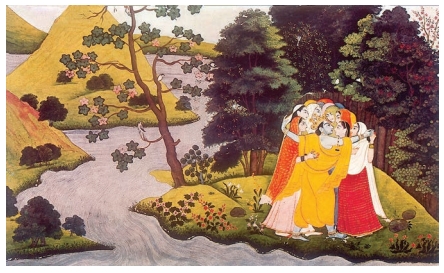
Krishna Embracing Gopis - A tender depiction of Lord Krishna embracing the Gopis, illustrating themes of divine love and Bhakti rasa central to Indian mythological narratives and Pahari art. - (i) He is highly renowned for his work on the famous Gita Govinda set, completed around , which is celebrated for effectively blending essential Basohli traits with the new, refined Guler elements.
- (ii) Manak was also a prolific artist of courtly life, creating numerous detailed portraits of his primary patron, Raja Govardhan Chand, and members of the royal family.
Nainsukh: The Pioneer of Individual Portraiture and Courtly Life
Nainsukh is arguably the most famous name associated with the Guler tradition, celebrated for introducing an intimate, almost documentary style to Pahari painting. His move to Jasrota marked a new phase in his career, dedicated to his patron Raja Balwant Singh.
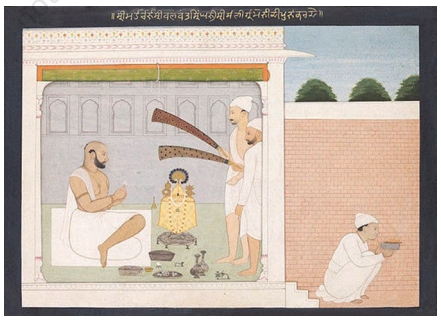
Balwant Singh in Prayer by Nainsukh - An iconic artwork by Nainsukh, capturing Raja Balwant Singh in a personal moment of prayer, demonstrating the artist's mastery over realism and the introspective nature of Guler portraiture. - (a) After his early work in Guler, Nainsukh relocated to Jasrota, where he served as the court painter for Raja Balwant Singh, establishing a close artistic relationship.
- (b) He masterfully captured his patron's life in diverse, lifelike activities, including scenes of the Raja performing puja (prayer) and surveying various sites, lending his work a unique biographical quality.
- (c) Nainsukh is recognized for his immense contribution to individual portraiture, which became a defining and celebrated hallmark of the subsequent Pahari style.
Successors and the Continuity of the Guler Kalam
The artistic legacy did not end with Pandit Seu's sons. The tradition was successfully carried forward by the next generation, ensuring the continuous flourishing of the refined Pahari art under new patronage.
- Khushala, Fattu, and Gaudhu: These artists, who were the sons and grandsons of Manak and Nainsukh, continued the esteemed family tradition. They played a significant role in the ongoing development and flourishing of Pahari art under Prakash Chand, who succeeded Raja Govardhan Chand in Guler.
4. Legacy and Enduring Influence: The Evolution into the Kangra School
The sophisticated principles and delicate techniques established by the Guler School were not confined to the state. They successfully migrated and evolved, leading directly to the establishment of the most celebrated style in the region, the Kangra School.
- (i) The refined mature Guler style achieved its ultimate destination in Kangra around the , where it transformed and evolved into the globally renowned Kangra School of Painting.
- (ii) Evidence suggests that Guler’s artistic tradition was long-standing, with works traceable to the reigns of Dalip Singh () and his son Bishan Singh, indicating artistic activity predating the famous Guler–Kangra phase itself.
- (iii) The offshoots of the original Basohli style, influenced by Guler's transition, also continued to thrive in other important hill states such as Chamba and Kullu.
⚡ Quick Revision Capsule: Guler School vs Basohli vs Kangra
A comparative glance at the key Pahari miniature style transitions across the 18th century:
| Feature / School | Basohli School | Guler School | Kangra School |
|---|---|---|---|
| Primary Era | Late to Early | Mid () | Late onwards () |
| Color Palette | Intense primary colors, strong yellow & red borders | Delicate pastel shades, subtle whites & greys | Rich naturalistic colors, soft lyrical shading |
| Key Key Figures | Raja Kirpal Pal, Devidasa | Pandit Seu, Manak, Nainsukh, Raja Govardhan Chand | Sansaar Chand, Khushala, Gaudhu, Fattu |
| Key Characteristics | Expressive faces, bold eyes, beetle-wing casing highlights | Refined naturalism, individual portraiture, delicate lines | Lyrical romanticism, lush landscapes, female grace |
| Famous Works | Rasamanjari series | Gita Govinda (), Portraits of Raja Balwant Singh | Bhariyan, Nala-Damayanti series |
📝 Summary
The Guler School is indispensable for understanding the art history of the , acting as the critical stylistic bridge between the intense Basohli works and the elegant Kangra miniatures. Led by artists like Nainsukh and Manak under the patronage of Raja Govardhan Chand, this movement introduced naturalism, subdued palettes, and refined portraiture to the hill states. For students, studying the Guler–Kangra kalam provides the essential context for tracing the evolution of Pahari miniature painting from its bold beginnings to its classical, naturalistic maturity.
🚀 Quick Revision Points
Essential facts to review before examinations:
- (i) The transition from Basohli to Guler style began in the early quarter of the .
- (ii) Pandit Seu and his sons Manak and Nainsukh were the central artists responsible for this shift.
- (iii) The Guler style substituted bold primary colors with soft pastel tones and broad grey/white background spaces.
- (iv) Nainsukh introduced an intimate, documentary style of personal court portraiture during his service to Raja Balwant Singh of Jasrota.
- 💡 Exam Tip: Questions frequently ask which artist bridged the Basohli and Guler styles—remember that Manak's Gita Govinda set () is the prime example of this transition!
❓ Frequently Asked Questions (FAQ)
Q1: Who were the main artists behind the Guler School of Painting?
A1: The movement was spearheaded by Pandit Seu and his two sons, Manak (Manaku) and Nainsukh, along with later family members like Khushala, Fattu, and Gaudhu.Q2: How does the color palette of Guler painting differ from Basohli painting?
A2: Basohli paintings used intense, vibrant primary colors, whereas Guler paintings introduced soft pastel shades and subtle uses of grey and white space.Q3: What was Nainsukh's major contribution to Pahari art?
A3: Nainsukh pioneered realistic, individual court portraiture, capturing candid and intimate moments of patron Raja Balwant Singh performing daily activities such as puja.