The Jaipur School of Painting, a colorful branch of the Rajasthan miniature tradition, started in the old capital of Amer. It created a special look by mixing local Rajasthani art with smooth Mughal styles. The growth of this school was supported by strong kings like Sawai Jai Singh. Studying this period is key for students learning art history and cultural exams, as it shows a lively time in Indian art during the .
🎯 In this chapter, you will understand:
- How political ties with the Mughal court shaped early Amer and Jaipur painting styles.
- The major contributions of royal patrons like Sawai Jai Singh and Sawai Pratap Singh.
- Key themes in Jaipur miniatures, including Vaishnavite devotion, portraiture, and court life.
- Stylistic shifts in the late 18th and 19th centuries, such as large-scale portraits and gold detailing.
💡 Why this topic matters: It reveals how regional Indian traditional art blended with imperial Mughal techniques to form a unique, lasting aesthetic.
🧠 Core Idea: Strategic political alliances led to a rich cultural exchange, giving birth to a distinct painting school known for royal portraits, devotional themes, and vibrant colors.
🎨 Jaipur School of Painting: Evolution, Royal Patronage, and Mughal Influence (16th–19th Century)
The roots of the Jaipur School are closely linked to the geographic location and friendly political bonds of its original center, Amer, with nearby Mughal hubs like Agra and Delhi.
- (i) The continuous diplomatic relation between the rulers of Amer (and later Jaipur) and the Mughals led to a strong exchange of ideas, shaping the early artwork of the region.
- (ii) The school started in Amer before the city of Jaipur was built, which made sharing artistic ideas with the Mughal court easy.
- (iii) Because of these strong bonds, early paintings from this area borrowed the fine details, natural look, and methods of Mughal painting.
Early Rulers, Strategic Alliances, and the Foundation of Mughal Artistic Exchange
The early years of the Jaipur lineage were guided by leaders who built political friendships with the Mughals. This opened doors for local artists to adopt imperial styles.
Raja Bharmal, Bhagwant Das, and Man Singh: Forging Close Mughal Ties
A series of early rulers set up the artistic fusion that defined this school. Raja Bharmal started this connection between by marrying his daughter to Emperor Akbar, bringing peace and cultural mixing.
- (i) Bhagwant Das (who ruled from ), son of Bharmal, was a close friend of Akbar, bringing the royal families even closer.
- (ii) His grandson, Man Singh, became Akbar's most trusted general, placing the Amer and Jaipur court right at the heart of Mughal political and cultural life.
👑 Sawai Jai Singh: The Pivotal Patronage and Development of the Distinct Jaipur Style
The true start of the unique Jaipur School is credited to Sawai Jai Singh (who ruled from ). He founded the new, well-planned city of Jaipur in and gathered artists in one central location.
The New Capital, Royal Atelier (Suratkhana), and Religious Themes
Sawai Jai Singh cared deeply about city planning and art. He organized the Suratkhana (the royal workshop for making and storing paintings) and brought trained Mughal painters from Delhi to make his court atelier stronger.
- (i) Hiring Artists:Mughal painters were brought from Delhi to mix their style with the work done at the Jaipur court.
- (ii) Rebuilding the Workshop: The Suratkhana was reorganized so artists and craftsmen could live and work in the new city long-term.
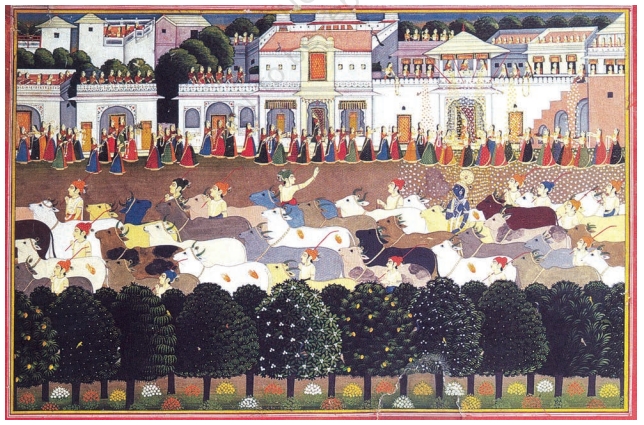
- (iii) Vaishnavite Devotion: Because he was a devoted follower of the Vaishnavite sect, he asked for many paintings showing scenes of Radha and Krishna.
- (iv) Poetry and Books: Artists created painted series based on famous books like Rasikapriya, Gita Govinda, Baramasa (the seasons), and the musical Ragamala collection, often painting the king as the hero.
The Flourishing of Portraiture and the Master Artist Sahibram
Under Sawai Jai Singh's support, royal portrait painting grew very popular. Painting the king and key court figures became a central focus of the Jaipur School.
- (a) The master painter Sahibram was a key member of the royal workshop who was famous for painting realistic portraits.
- (b) Portraits were used both as beautiful art and as a way to show and confirm royal authority.
🏛️ Successive Rulers: Sawai Ishwari Singh and Sawai Madho Singh (1743–1767)
After Sawai Jai Singh, the rulers who followed kept supporting art. They expanded the topics to show everyday royal life, sports, and court events.
Sawai Ishwari Singh: Capturing Royal Leisure and Pastimes
During the brief reign of Sawai Ishwari Singh (), paintings began to show the fun and personal activities of the royal family.
- (i) Common themes included active scenes of boar and tiger hunts to show the king's courage.
- (ii) Pictures of exciting elephant fights and calm elephant rides were also painted often to highlight court life.
Sawai Madho Singh: Documenting Incidents of Court Life
Sawai Madho Singh () asked artists to record important official events, capturing real incidents from court life for the future.
- (a) These artworks give us a clear view of the order, habits, and buildings of the Jaipur court during his time.
🖌️ Sawai Pratap Singh: Reformation, Indigenous Style Revival, and Prolific Output (1779–1803)
The time of Sawai Pratap Singh was a second golden age for the Jaipur School. As the Mughal influence grew weaker, a fresh look came up that smoothly blended the best of Mughal and native Rajasthani styles.
The New Jaipur Style: Blending Aesthetics and Renewal of Religious Themes
Pratap Singh was a writer, poet, and dedicated follower of Krishna. He brought a spiritual and literary renewal to his court, employing nearly 50 artists in his Suratkhana.
- (i) Style Change: The paintings took on a distinct Jaipur identity that moved away from pure Mughal style, focusing more on local colors and shapes.
- (ii) Religious and Literary Themes: The focus returned to stories of faith and poetry, including new sets of Gita Govinda, Ragamala, and Bhagvata Purana.
- (iii) Court Scenes: Alongside religious art, making royal portraits and scenes of court life remained very popular.
✨ Late 18th and Early 19th Century: Trends in Technique and Scale
In its later years, the Jaipur School adopted new stylistic habits and techniques that showed a desire for grand looks and faster painting methods.
Lavish Use of Gold and the Popularity of Large-Format Portraits
By the early , artists used a lot of gold paint in their miniatures to make them look rich. At the same time, the physical size of the paintings grew much larger.
- (i) Larger Sizes: Paintings were made in a large format, with a clear trend toward making life-size portraits of royal figures.
- (ii) Tracing Techniques: Artists started using methods like tracing and pouncing to copy popular designs quickly, helping them make more paintings in less time.
🏛️ Significance of the Jaipur School: Blending Traditions and Art Historical Importance
The Jaipur School of Painting is a great example of mixing different cultures. It shows how Mughal elegance blended smoothly with local Rajasthani spirit. Rulers like Sawai Jai Singh and Sawai Pratap Singh helped the arts thrive, leaving behind many works about holy stories like Radha and Krishna as well as court records. For students, studying Jaipur miniatures helps in understanding how royal support shaped Rajasthani art between the .
⚡ Quick Revision Capsule: Jaipur School Rulers & Artistic Shifts
A quick comparison of key rulers and their major contributions to the Jaipur School of Painting:
| Ruler / Era | Key Contributions & Themes | Stylistic Features |
|---|---|---|
| Raja Bharmal & Early Rulers () | Forged diplomatic ties with Akbar; established political connections at Amer. | Early introduction of Mughal painting techniques and naturalism. |
| Sawai Jai Singh () | Founded Jaipur (), reorganized Suratkhana, commissioned Gita Govinda and Ragamala. | Vaishnavite devotional themes (Radha-Krishna) and lifelike royal portraits by Sahibram. |
| Sawai Ishwari Singh () | Shifted focus to royal leisure, tiger/boar hunts, and elephant fights. | Action-oriented court scenes and sports depictions. |
| Sawai Madho Singh () | Documented official court ceremonies and daily incidents. | Visual record of court hierarchy, rituals, and architecture. |
| Sawai Pratap Singh () | Employed ~50 artists; commissioned Bhagvata Purana and Ragamala. | Second golden era; distinct Jaipur identity blending Mughal and local elements. |
| Early 19th Century | Shift toward grand displays and mass reproduction. | Heavy use of gold, life-size portraits, and tracing/pouncing techniques. |
📝 Summary
The Jaipur School developed between the from its original seat in Amer to the planned capital of Jaipur. Guided by visionary rulers, the style evolved from heavy Mughal reliance to a distinct local identity celebrated for its portraits, devotional subjects like Radha-Krishna, and rich illustrated sets like the Gita Govinda.
🚀 Quick Revision Points
Essential facts to review before examinations:
- (i) Origin: Started at Amer and moved to Jaipur in under Sawai Jai Singh.
- (ii) Royal Workshop: The Suratkhana served as the central hub for making and storing art.
- (iii) Key Painters: Master artist Sahibram was famous for detailed royal portraits.
- (iv) Popular Texts: Illustrated sets included Rasikapriya, Gita Govinda, Baramasa, and Ragamala.
- 💡 Exam Tip: Remember that Jaipur School art transitioned through two major phases: an early Mughal-dominated phase starting under Raja Bharmal, and a strong local revival (second golden age) under Sawai Pratap Singh.
❓ Frequently Asked Questions (FAQ)
Q1: Who established the Suratkhana and why was it important?
A1: Sawai Jai Singh reorganized the Suratkhana as a centralized royal painting workshop in the new capital of Jaipur to support continuous artistic creation.Q2: What themes were prominent under Sawai Ishwari Singh?
A2: Paintings under Sawai Ishwari Singh focused on royal leisure pursuits, including boar/tiger hunts, elephant rides, and elephant fights.Q3: What methods were used in the 19th century to reproduce paintings?
A3: Artists used techniques like tracing and pouncing to quickly reproduce popular compositions in large formats.