The Kota School of Painting, a celebrated style within the larger Rajput miniature tradition, is instantly recognizable for its dramatic and highly detailed hunting scenes and wildlife depictions. Emerging after the kingdom's split from Bundi in , this school showcases a unique fusion of passion and spontaneity, making it an extremely important topic for students preparing for art history and competitive exams focusing on Indian painting schools.
🎯 In this chapter, you will understand:
- The political separation of Kota from Bundi and its role in creating a distinct art style.
- How Kota art transitioned from Bundi influence to its own dynamic identity.
- The major royal patrons who shaped the focus on landscapes and hunting scenes.
- Key technical features, shading styles, and environmental details in Kota miniature paintings.
💡 Why this topic matters: Kota paintings offer an unmatched visual record of royal sports, natural wilderness, and dynamic action within Indian art history.
🧠 Core Idea: Born out of Bundi traditions in , the Kota School carved its own niche through expressive drawing, marked shading, vibrant landscapes, and thrilling royal hunting expeditions.
Kota School of Painting: Evolution, Features, and Dramatic Hunting Scenes (17th–19th Century)
The Kota School of Painting developed as a distinct and powerful artistic tradition, initially influenced by its parent, the Bundi school, before forging its own unique identity.
The genesis of the Kota style is rooted in its proximity and shared history with Bundi, yet it rapidly matured into a unique narrative style that captured the visceral excitement of the royal court's favorite pastime.
- (i) The school achieved exceptional fame primarily through its mastery in depicting intense hunting scenes and the thrilling pursuit of animal chase across varied terrains.
- (ii) A defining characteristic woven into the fabric of these artworks is the palpable atmosphere of excitement, mirroring the royal passion for wildlife and gaming.
Historical Background and Political Genesis of Kota State
The separation of Kota from the Bundi kingdom provided the necessary political and administrative space for a distinct art style to flourish, driven by the patronage of its independent rulers.
Division of Bundi and Establishment of Kota
Historically, the region of Kota was an integral part of the larger Bundi kingdom until the significant year of . This separation was a momentous political event orchestrated by the Mughal Emperor, Jahangir.
- (i) The crucial division was granted as a distinguished reward to Madhu Singh, acknowledging his remarkable bravery and loyal services.
- (ii) This act of imperial favor was specifically for Madhu Singh's success in defending Jahangir against the rebellion led by his own son, Prince Khurram, who later ascended the throne as Emperor Shah Jahan.
Early Development Under Jagat Singh
The independent development of the Kota painting school began to solidify around the , marking the initial divergence from the Bundi style under the reign of Jagat Singh ().
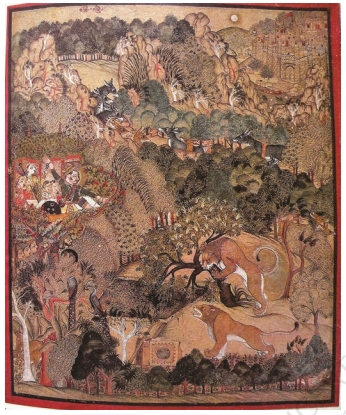
Maharaja Ram Singh Hunting Lions - A regal painting from the Kota School, depicting Maharaja Ram Singh in a dramatic lion hunting scene, showcasing the valor and hunting skills of the Rajput kings, with intricate detailing and bold colors, a testament to the school's focus on royal sport. - (a) This period laid the groundwork for the school's future unique aesthetics, despite the heavy initial reliance on Bundi's artistic conventions.
- (b) The patronage provided by the newly independent court was vital in attracting and encouraging artists to experiment and evolve their stylistic vocabulary.
Evolution of Style: From Bundi Influence to Kota Uniqueness
Though initially sharing a common visual language, the Kota school gradually developed distinct stylistic markers that differentiated it from its predecessor, showcasing greater boldness and dynamic representation.
Initial Similarity and Subsequent Divergence
In the nascent years of the Kota school, the artistic output was often indistinguishable from that of Bundi, as Kota artists extensively borrowed and adapted the prevailing Bundi artistic styles and themes.
- (i) However, a non-conformity began to emerge over time, notably manifesting in the portrayal of exaggerated figures and the design of architectural settings within the compositions.
- (ii) Kota's inherent flair for dynamic and expressive drawing became a uniquely recognizable trait, ultimately lending the style its powerful, independent character.
Key Developments and Royal Patronage
The thematic scope and prominence of specific subjects shifted dramatically under the influence of various rulers, with royal interests dictating the course of artistic production.
- Under Ram Singh I (): Kota artists broadened their subject matter beyond the traditional court themes, incorporating detailed landscape elements as a central and independent focal theme in their work.
- Under Umed Singh (): The obsession of the king with wildlife and gaming cemented hunting scenes as the absolute central theme of the Kota School.
- Paintings as Records: These artworks often served as vivid and detailed historical records of royal hunting expeditions, sometimes including the surprising depiction of court women participating in the perilous chase.
Salient Characteristics of Kota Miniature Painting
The mature Kota style is defined by a bold, spontaneous execution and a profound focus on action, drama, and the integration of lush natural settings.
Spontaneous Execution and Shading Techniques
The technical quality of Kota paintings is characterized by a spontaneous and almost calligraphic execution, which imbues the dynamic scenes with immediate energy and life.
- (i) A distinct feature is the presence of marked shading, which adds depth and volume, especially noticeable in the unique rendering of the double-lid eye of the human figures.
- (ii) The artists demonstrated an exquisite skill in the rendering of animals—capturing their raw power and movement—and in the dramatic composition of combat scenes.
Focus on Landscape and Dynamic Composition
Unlike many other schools where landscape was merely a backdrop, in Kota painting, the natural environment plays an equally vital role, setting the stage for high-octane action.
- (a) The depiction of lush landscapes is handled with great detail, establishing the environment as an integral and active element of the entire composition.
- (b) The resulting compositions are consistently dynamic and action-filled, masterfully capturing the climax and the intense momentum of the chase, which is the hallmark of the Kota style.
⚡ Quick Revision Capsule: Kota School of Painting
A quick comparison of key rulers, artistic shifts, and unique visual elements of the Kota miniature tradition:
| Aspect | Historical Details | Artistic Focus |
|---|---|---|
| Political Origin | Split from Bundi in by Mughal Emperor Jahangir | Granted to Madhu Singh for bravery during Prince Khurram's revolt |
| Early Phase | Reign of Jagat Singh () | Heavily influenced by Bundi styles; gradually developed unique figures |
| Landscape Innovation | Reign of Ram Singh I () | Expanded focus on dense, detailed jungle landscapes as main themes |
| Golden Era of Hunting | Reign of Umed Singh () | Centering on hunting scenes, dangerous wild animals, and women hunting |
| Key Visual Traits | Calligraphic lines, marked shading, double-lid eyes | Dynamic action, raw energy, and dense forest settings |
📝 Summary
The Kota School of Painting stands as a testament to the distinct aesthetic preferences nurtured under Rajput patronage following the separation from Bundi in . Its singular focus on dramatic hunting scenes, spontaneous execution, and integral landscape elements distinguishes it within the Hadoti region's artistic output. Understanding the stylistic evolution from Jagat Singh to the wildlife-obsessed Umed Singh is crucial for students of art history, as the school beautifully encapsulates the intersection of royal passion and artistic expression in the Indian miniature painting tradition.
🚀 Quick Revision Points
Essential facts to review before examinations:
- (i) Established in when Mughal Emperor Jahangir granted Kota to Madhu Singh.
- (ii) Transitioned from Bundi-style copies to bold, action-packed original artworks with marked shading.
- (iii) Famous for depicting royal sports, lion hunts, and female court members participating in hunting expeditions.
- (iv) Features distinctive human facial treatments such as double-lid eyes and exaggerated figures.
- 💡 Exam Tip: When answering questions on Hadoti miniature art, remember that Bundi is famous for lush vegetation and romantic themes, while Kota is specifically distinguished by dramatic hunting scenes and wild animal pursuits.
❓ Frequently Asked Questions (FAQ)
Q1: When did Kota separate from Bundi and become an independent state?
A1: Kota separated from the Bundi kingdom in when Mughal Emperor Jahangir awarded the region to Madhu Singh.Q2: What is the primary thematic subject of the Kota School of Painting?
A2: While early works showed Bundi influence, Kota art is most famous for its dynamic hunting scenes, animal chases, and jungle landscapes.Q3: Who was the ruler under whom Kota hunting paintings reached their peak?
A3: Under Maharaja Umed Singh (), royal obsession with gaming and wildlife made hunting the absolute central subject of the school.