Embark on a journey through the masterful artistry of Indian Miniature Painting, a vibrant tradition showcasing rich cultural, spiritual, and courtly stories across different regional styles. This detailed guide explores key artworks, including the Malwa School's depiction of the Bhagavata Purana, the romantic Maru Ragini from Mewar, and the famous Bani Thani of Kishangarh. These paintings, made between and , offer deep insights into religious devotion, royal life, and local artistic styles for students preparing for art history and culture exams.
🎯 In this chapter, you will understand:
- How regional schools like Mewar, Malwa, Jodhpur, and Kishangarh developed their own distinct artistic styles.
- The visual storytelling techniques used to illustrate sacred texts like the Ramayana and Bhagavata Purana.
- The role of royal patrons, famous painters, and local folklore in shaping courtly art.
- Key artistic features, colors, and compositions needed for exam preparation in Indian art history.
💡 Why this topic matters: Indian miniature paintings show how royal courts, regional traditions, and sacred stories combined to create world-famous visual art.
🧠 Core Idea: Miniature paintings used detailed brushwork, vivid colors, and clever framing to tell complex stories of gods, kings, and lovers on small canvases.
🖼️ Masterpieces of Indian Miniature Painting: Style, Context, and Significance (17th–19th Century)
A collection of seven exquisite miniature paintings offers a window into the diverse themes and distinctive regional styles that flourished across India's artistic landscape during the late 17th and 18th centuries.
These selected works illustrate the evolution of court patronage, the visual portrayal of revered texts like the Ramayana and Bhagavata Purana, and the unique styles of centers like Mewar, Malwa, Jodhpur, and Kishangarh, which are essential for understanding historical art movements.
- (i) Sacred books like the Bhagavata Purana were painted with rich narrative detail, often using divided spaces to show continuous story events.
- (ii) Themes included the devotion toward Lord Krishna and Lord Rama, romantic musical compositions known as Ragamala, and grand portraits of kings.
- (iii) Famous styles stood out clearly, such as the long, elegant faces of the Kishangarh style and the bold, vivid colors of the Malwa tradition.
🎨 Illustrating Scenes from the Bhagavata Purana: The Malwa Style Narrative of Krishna
This section explores a powerful story painting from the Malwa region. It demonstrates how artists divided the picture space to show multiple scenes from a single story in sequence.
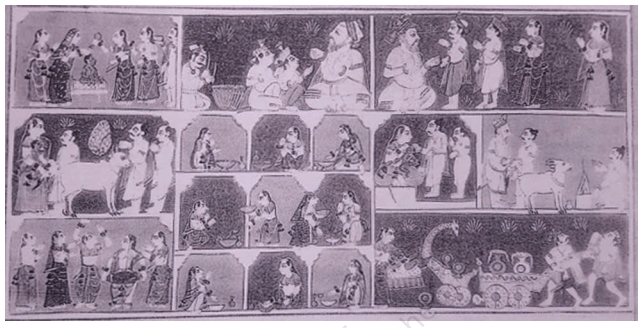
The Killing of Shakatasura by Lord Krishna ()
Housed in the National Museum, New Delhi, this painting is a clear example of the Malwa style. It focuses on the early childhood of Lord Krishna and ends with him defeating the demon Shakatasura. The artwork is neatly divided into separate boxes, allowing the viewer to follow the story step by step across the painting.
- (i) The story starts with joyous festivities and celebrations for the birth of Krishna at the home of Nanda and Yashoda, shown in the lower left and upper middle areas.
- (ii) Acts of charity by Nanda and Yashoda show them giving cows and calves to priest families (Brahmins) and friends on the left and far right sides, pointing out the value of these traditions.
- (iii) The middle section shows people preparing tasty food for a big community feast.
- (iv) In the upper left corner, loving women watch over baby Krishna closely to protect him from evil spirits and harm.
- (v) The story reaches its climax as the baby Krishnaknocks over the cart demon, Shakatasura, with just a gentle kick, showing his divine power.
Maru Ragini from Mewar: A Romantic Musical Ballad
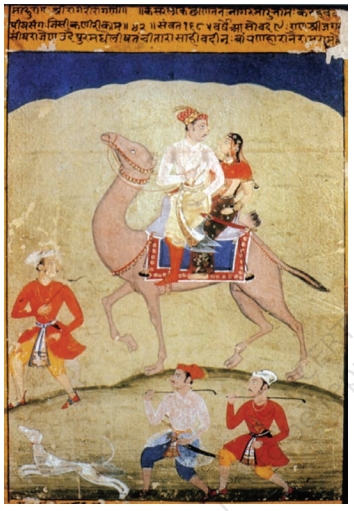
Maru Ragini - A beautiful example of Ragamala painting depicting the Maru Ragini, part of the Ragamala series, capturing the essence of desert landscapes through a musical theme, symbolizing the scorching heat and emotions associated with it. This is a well-known work from the Mewar region, belonging to the Ragamala series of paintings that turn musical modes into visual scenes. This painting includes historical record details, stating the name of the artist, Sahibdin, and his royal sponsor, Rana Shri Jagat Singh of Udaipur. It portrays Maru, the partner of Raga Shri, as told in the popular desert folk tale, the Dhola-Maru ballad.
- (i) The artwork clearly shows the feelings and long travel of the lovers, Dhola and Maru, as they escape together on a camel.
- (ii) This scene symbolizes their struggle to stay together despite facing hard challenges, matching the deep mood of the music.
Equestrian Portrait of Raja Aniruddha Singh: Capturing Speed and Movement
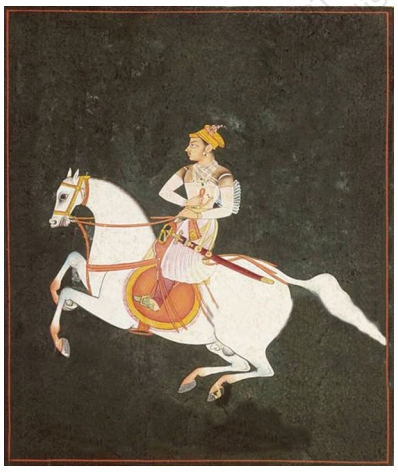
Portrait of Raja Aniruddha Singh by Tulchi Ram - An exquisite portrait from the Rajasthan School, depicting Raja Aniruddha Singh in royal attire. This painting showcases the fine details of Mughal-influenced Rajasthan art, highlighting the king’s regal stature. Made around by the artist Tulchi Ram, this striking painting shows prince Aniruddha Singh riding a horse. The main goal of this artwork is to show rapid movement and energy. The painter chose to draw the horse running so fast that the ground is left completely out of the picture, giving a strong feeling of speed and royal strength.
- (i) The portrait includes written notes on the painting that confirm the identities of both Aniruddha Singh and Bharat Singh.
🏇 Royal Sports and Divine Themes in Later Miniature Styles
Later miniature paintings explored court pastimes, divine love stories, and iconic human forms across different regional centers.
Chaugan Play (Polo) by Dana: A Look at Royal Pastimes
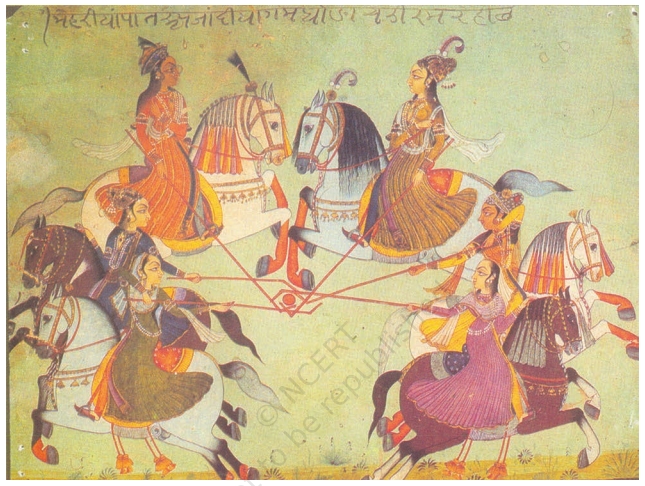
Chaugan Players by Dana - A painting by Dana depicting a royal game of Chaugan (polo), a sport favored by the Mughal and Rajput kings, showcasing the elegance and grandeur of this royal pastime in traditional Indian miniature art. Painted by the artist Dana during the rule of Man Singh of Jodhpur around , this lively artwork shows a game of Chaugan (Polo). It features a royal princess actively playing the sport with her companions. This piece combines styles from various regions, making it a great study example for art students.
- (i) The painting shows design details from Mughal artists, color choices from the Deccan region, and features from the Bundi and Kishangarh traditions.
- (ii) An inscription on the painting translates to: "Beautiful maidens on horseback, playing," which confirms what the scene represents.
Krishna Swinging and Radha in Sad Mood by Nuruddin: Rasikapriya Theme
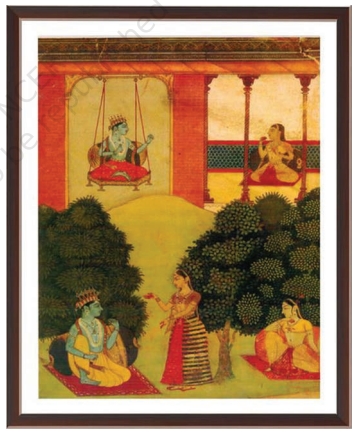
Rasikapriya by Nuruddin - A masterpiece by the Mughal artist Nuruddin, illustrating scenes from the Rasikapriya, an ancient text celebrating the divine love between Radha and Krishna, rendered in fine Mughal miniature style. Created in by the painter Nuruddin at the Bikaner court, this work shows scenes inspired by the classic poem Rasikapriya. The layout focuses on feelings of love and longing between Radha and Krishna.
- (i) The artwork presents two contrasting feelings: Krishna is happily enjoying a swing with a cowherd maiden (Gopi).
- (ii) Nearby, Radha is shown feeling sad and hurt, walking away into the trees because she feels ignored.
- (iii) A close friend (Sakhi) acts as a helpful messenger, asking Krishna to go back and make peace with his beloved Radha.
Bani Thani by Nihal Chand: The Famous Kishangarh Style
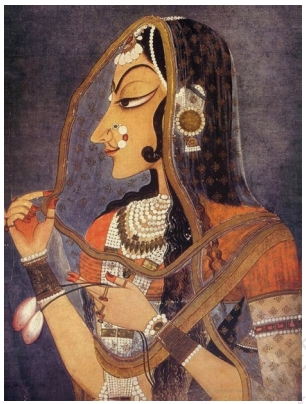
Bani Thani by Nihal Chand - A classic example of Kishangarh School of painting, featuring the famous Bani Thani, known for her delicate features and poetic expression of love, often compared to the divine beauty of Radha. The famous portrait of Bani Thani is the most celebrated artwork from the Kishangarh school, painted by the artist Nihal Chand. Beyond being a simple portrait, it stands as a symbol of divine beauty, portraying Bani Thani as the goddess Radha, which is essential for exam preparation.
- (i) The real-life subject, Bani Thani, was deeply admired by king Sawant Singh, who wrote poems for her and supported art in his court.
- (ii) Her portrait is known for distinct and stylishly drawn facial features that became the main trademark of the Kishangarh style.
- (iii) These key features include long, pointed eyes, gently curved eyebrows, and a fine, sharp nose.
Rama Meets Members of His Family in Ramayana by Guman: Continuous Storytelling
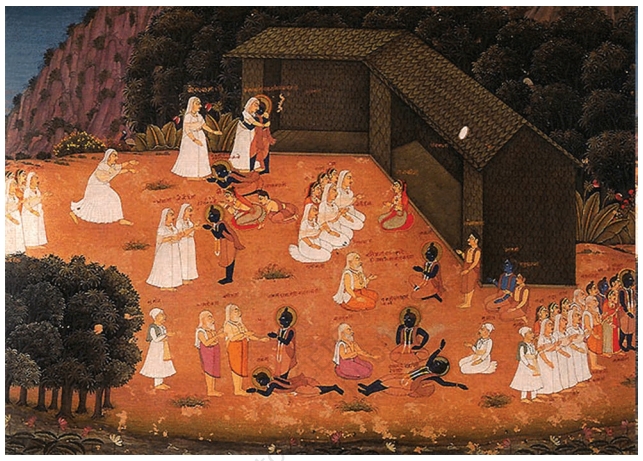
Painting of Ramayana by Guman - A detailed miniature painting by the artist Guman, portraying key episodes from the Ramayana, with a focus on the devotion, valor, and divine acts of Lord Rama. Created between and by the artist Guman, this artwork uses continuous story steps to depict a scene from the Ramayana. It highlights the emotional story after king Dashratha passes away, focusing on the request made to Lord Rama.
- (i) The main scene shows Bharatasking Rama to come back from the forest to Ayodhya and take his place as the rightful king.
- (ii) The visual layout moves from left to right, showing meetings between Rama, his family members, and wise elders (Sages) in a peaceful forest setting.
⚡ Quick Revision Capsule: Indian Miniature Masterpieces Summary
Here is a concise overview of the seven primary miniature masterpieces, their origins, artists, and key stylistic characteristics for study review.
| Masterpiece Title | School & Era | Artist & Key Features |
|---|---|---|
| Killing of Shakatasura | Malwa School () | Divided scene boxes showing Krishna defeating the cart demon Shakatasura. |
| Maru Ragini | Mewar School () | Painted by Sahibdin; shows Dhola and Maru riding a camel in a musical Ragamala mode. |
| Portrait of Raja Aniruddha Singh | Bundi School () | Painted by Tulchi Ram; shows a galloping horse with no ground line to express fast motion. |
| Chaugan Players | Jodhpur School () | Painted by Dana; depicts women playing Polo, blending Mughal, Deccan, and local styles. |
| Krishna Swinging & Radha | Bikaner School () | Painted by Nuruddin; based on Rasikapriya showing Radha feeling upset while Krishna swings. |
| Bani Thani | Kishangarh School () | Painted by Nihal Chand; famous for long eyes, sharp nose, and portraying Bani Thani as Radha. |
| Rama Meets His Family | Jaipur/Pali School () | Painted by Guman; shows continuous story scenes from the Ramayana moving left to right. |
📝 Summary
These seven masterpieces serve as an essential study resource for understanding the rich variety of Indian miniature painting between the and . They demonstrate how devotional literature like the Bhagavata Purana, romantic ballads like Maru Ragini, and court life were captured on paper. Works by renowned painters like Sahibdin, Tulchi Ram, Nuruddin, Dana, Nihal Chand, and Guman reflect how regional creativity built the artistic heritage of Indian Art and Culture.
🚀 Quick Revision Points
Essential facts to review before examinations:
- (i) Malwa School: Known for narrative compartments and vivid color backgrounds.
- (ii) Mewar School: Famous for Ragamala paintings with documented artist names like Sahibdin.
- (iii) Kishangarh Style: Recognized worldwide for Nihal Chand'sBani Thani with elongated eyes and pointed nose.
- (iv) Visual Storytelling: Works by Guman used continuous left-to-right storytelling to show epic scenes from the Ramayana.
- 💡 Exam Tip: When answering questions on miniature art, mention the artist name, patron king, school of art, and specific visual traits like eye shapes or spatial division.
❓ Frequently Asked Questions (FAQ)
Q1: What is the main characteristic of the Malwa painting style?
A1: The Malwa style is famous for dividing the canvas into neat compartments to show step-by-step scenes from stories like the Bhagavata Purana.Q2: Who painted Bani Thani and why is it famous?
A2: It was painted by Nihal Chand in the Kishangarh court. It is famous for its distinct features like sharp noses, long eyes, and for depicting Bani Thani as goddess Radha.Q3: What are Ragamala paintings?
A3: Ragamala paintings are visual artworks that depict Indian musical modes (Ragas) through romantic human figures and seasonal scenes, such as Maru Ragini.