The Second Anglo-Mysore War () represents a critical turning point in 18th-century Indian history, highlighting British betrayal, strategic French alliances, and the formidable leadership of Haidar Ali and his son, Tipu Sultan. Triggered fundamentally by the British breach of the preceding Treaty of Madras and escalating conflicts over the key French settlement of Mahe, this four-year war witnessed dramatic military victories and painful setbacks for both sides before reaching an inconclusive resolution with the signing of the Treaty of Mangalore. For students and exam aspirants, understanding this pivotal conflict is crucial for grasping the intricacies of colonial diplomacy, major military campaigns, and shifting Indo-European alliances during the rise of British power in India.
🎯 In this chapter, you will understand:
- The root causes of British betrayal and Mysore's alliance with the French.
- The military course, key battles, and diplomatic shifts between and .
- The transition of leadership to Tipu Sultan after the death of Haidar Ali.
- The significance and terms of the equal status Treaty of Mangalore ().
💡 Why this topic matters: It demonstrates how regional Indian states leveraged European geopolitical rivalries to counter British expansionism.
🧠 Core Idea: A balanced military conflict driven by broken promises, strategic diplomacy, and resilient defense of regional sovereignty.
The Second Anglo-Mysore War (): Background and Causes
The fierce conflict was precipitated by the British betrayal of Haidar Ali, pushing him towards a crucial strategic alliance with the French. The powerful ruler of Mysore, Haidar Ali, accused the British East India Company of repeatedly violating previous treaty terms, leading him to seek French support and setting the stage for open war.
Roots of Discontent and Geopolitical Shifts
Multiple diplomatic and military factors combined to make open warfare between Mysore and the British East India Company unavoidable:
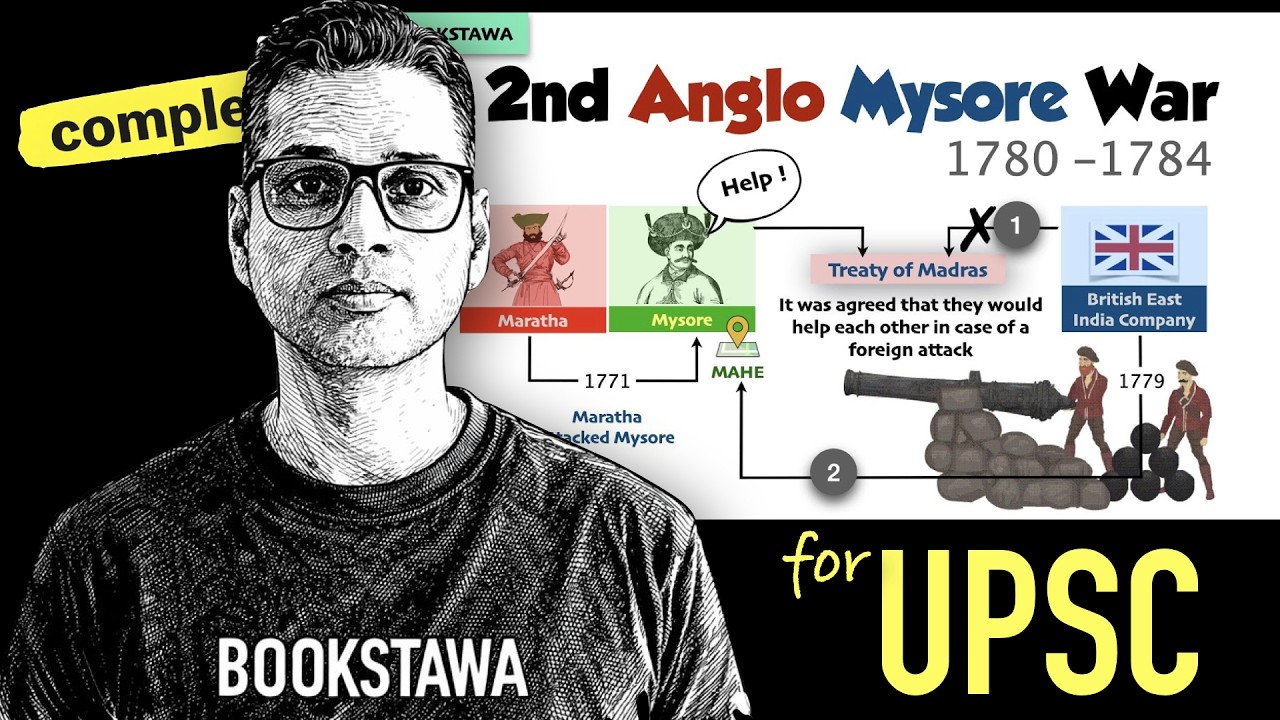
- (i) The root of betrayal stemmed from , when Mysore was attacked by the Marathas and the British failed to honor the defensive clause in the Treaty of Madras by refusing military aid.
- (ii) Strategic importance of the French grew as they supplied Mysore with essential military goods, including guns, saltpetre, and lead, through the port of Mahe on the Malabar Coast.
- (iii) The wider geopolitical context of the American War of Independence made the French actively hostile to the British, creating a favorable climate for an Indo-French alignment.
- (iv) Haidar Ali viewed the British attempt to capture the French port of Mahe as a direct challenge to his authority, making war unavoidable.
Course of the War: Haidar’s Strategic Alliance and Early Triumphs
Initially, Haidar Ali successfully forged an alliance with two major regional powers and secured significant victories against the British forces, demonstrating his military strength.

Forging the Anti-British Alliance with Marathas and the Nizam
Recognizing the need for collective strength against the encroaching British power, Haidar Ali strengthened his position by joining forces with key regional entities.
- (i) He negotiated an alliance with the Marathas and the Nizam of Hyderabad to jointly oppose the British East India Company.
- (ii) Following this diplomatic step, Haidar Ali’s combined forces advanced into the Carnatic region and captured the vital city of Arcot.
Key Battles and the Shifting Fortunes of War ()
The middle years of the war saw fortunes constantly alternate, marked by both major successes for Mysore and severe setbacks.
- (i) In an early engagement, British forces under Colonel Baillie suffered a crushing defeat against Haidar’s army.
- (ii) However, Sir Eyre Coote skillfully detached the Marathas and the Nizam from their alliance with Haidar through diplomatic maneuvering.
- (iii) In , Haidar Ali suffered a major setback at the Battle of Porto Novo against British forces.
- (iv) Despite this loss, Haidar’s forces regrouped quickly, defeating the British again and capturing commander Braithwaite.
The Resolution: Treaty of Mangalore () and Tipu Sultan’s Continuation
Hostilities drew to an inconclusive close following the death of Haidar Ali and the continued struggle by his son, Tipu Sultan.
Death of Haidar Ali and Tipu Sultan Takes Command ()
The leadership of the Mysorean campaign transitioned mid-war, altering the dynamics of the conflict.
Tipu Sultan continued the war for another year following his father's death. - (i) Haidar Ali passed away on due to cancer, leaving a void in military command.
- (ii) His son, Tipu Sultan, carried on the fight against the British for another full year without a decisive breakthrough.
- (iii) Exhausted by prolonged conflict, both sides agreed to cease hostilities and begin peace talks.
Key Terms of the Treaty of Mangalore: An Equal Treaty Status
The peace agreement, finalized in , was notable for its equal footing between the two sides.
- (i) The formal agreement was signed in Mangalore in , bringing the war to an end.
- (ii) The core provision was the mutual restoration of all captured territories and prisoners to the pre-war status quo.
- (iii) Because neither side gained a decisive advantage, the treaty established terms of virtual equality—a rare occurrence in British-Indian diplomacy.
⚡ Quick Revision Capsule: Second Anglo-Mysore War
A structured snapshot of key milestones, dates, leaders, and diplomatic outcomes of the war.
| Key Event / Aspect | Details & Timeline | Historical Significance |
|---|---|---|
| Primary Trigger | British breach of Treaty of Madras & capture of Mahe | Forced Haidar Ali into an alliance with the French. |
| Grand Alliance formed | : Joined with Marathas & Nizam of Hyderabad | Successfully captured Arcot in early campaigns. |
| Battle of Porto Novo | : Led by British General Sir Eyre Coote | A major defeat for Haidar Ali, halting his momentum. |
| Leadership Transition | : Death of Haidar Ali | Tipu Sultan assumed command and continued fighting. |
| Treaty of Mangalore | : Signed between Mysore & British | Ended war on equal status with mutual land restoration (status quo ante bellum). |
📝 Summary
The Second Anglo-Mysore War () definitively exposed British betrayal regarding treaty obligations and highlighted the determination of Haidar Ali, who utilized French support to counter colonial expansion. Despite early Mysorean victories, diplomatic efforts by Sir Eyre Coote and battles like Porto Novo balanced the scales. Following the death of Haidar Ali in , Tipu Sultan continued the struggle, leading to the remarkable Treaty of Mangalore in . This war remains essential for studying colonial diplomacy and 18th-century regional power balances in India.
🚀 Quick Revision Points
Essential facts to review before examinations:
- (i) The war was triggered by British violations of the Treaty of Madras and the attack on Mahe.
- (ii) Haidar Ali formed a coalition with the Marathas and the Nizam of Hyderabad in .
- (iii) British commander Sir Eyre Coote defeated Haidar Ali at Porto Novo in .
- (iv) The war ended with the Treaty of Mangalore (), restoring all captured territories.
- 💡 Exam Tip: Remember that the Treaty of Mangalore was the last peace treaty signed by an Indian ruler with the British on equal terms.
❓ Frequently Asked Questions (FAQ)
Q1: What caused the Second Anglo-Mysore War?
A1: The primary causes were the British failure to help Mysore against the Marathas in as agreed in the Treaty of Madras, and the British attempt to capture the French port of Mahe.Q2: What was the outcome of the Treaty of Mangalore in 1784?
A2: Signed in by Tipu Sultan and the British, it ended the war on the basis of mutual restoration of conquered territories (status quo ante bellum).Q3: Who led the Mysorean and British forces during the war?
A3: Mysore was led by Haidar Ali until his death in , after which his son Tipu Sultan took command. British forces were led by generals including Colonel Baillie and Sir Eyre Coote.