Explore the intricate Legislative Procedure in State Legislature, a vital topic for Indian Polity studies. This detailed guide explains how an Ordinary Bill travels through the State Legislature, how the Legislative Assembly and Legislative Council work together, and how the Governor and the President of India give the final approval. It is an essential resource for students and competitive-exam aspirants preparing for UPSC and State PSC examinations.
🎯 In this chapter, you will understand:
- How an Ordinary Bill is introduced, debated, and passed in a State Legislature.
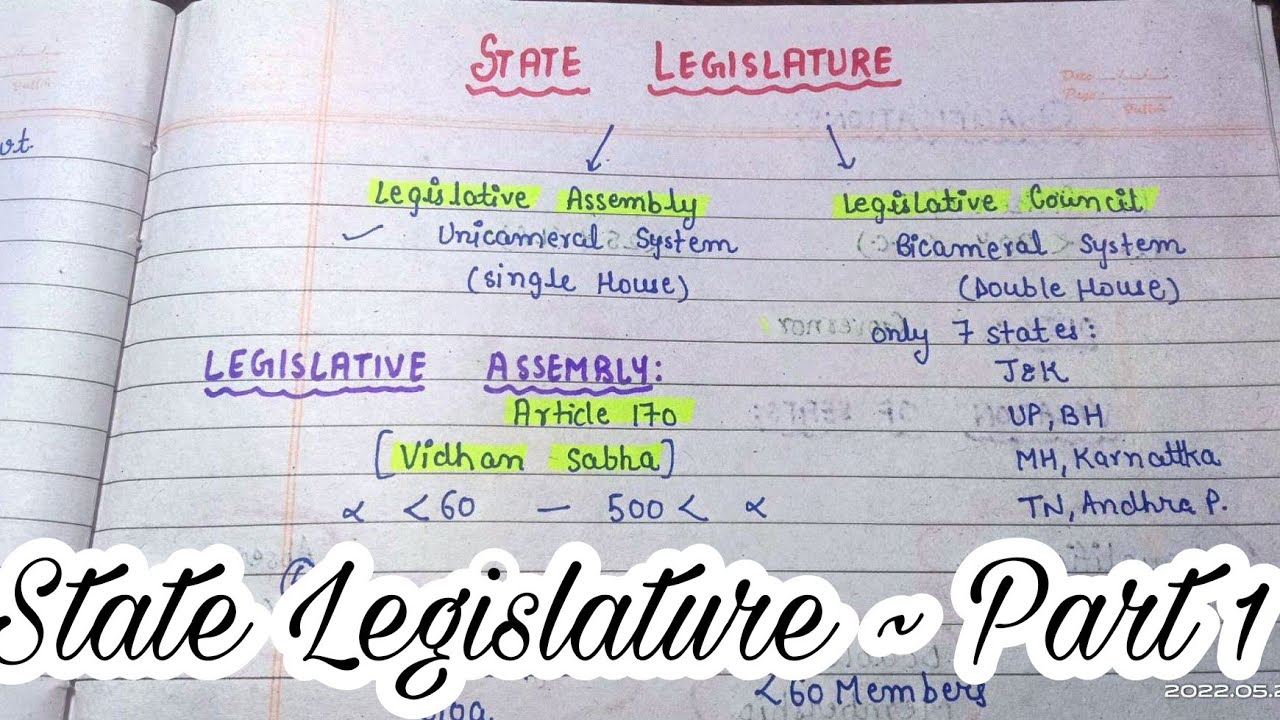
- The difference between a Unicameral and a Bicameral State Legislature.
- Why the Legislative Assembly is more powerful than the Legislative Council.
- The constitutional choices available to the Governor and the President when a State Bill is presented for assent.
💡 Why this topic matters: The making of a State law affects schools, hospitals, local administration, land rules, public welfare, and many everyday services. By learning this procedure, students can understand how democratic decisions are checked, debated, and finally converted into enforceable laws.
🧠 Core Idea: An Ordinary Bill must be carefully discussed before it becomes law. In States with two Houses, the Assembly has the final say because the Council can only delay it for a limited period. After the Legislature passes the Bill, the Governor’s assent is normally required; in special cases, the Bill may be reserved for the President.
Legislative Procedure in State Legislature: The Journey of an Ordinary Bill
The passage of a law within a State is a structured story of democratic checks and balances. In Indian governance, a proposal does not become a law simply because someone suggests it. It must first be written as a Bill, then introduced in the proper legislative House, discussed in detail, voted upon, and finally approved by the constitutional authority concerned. This careful process ensures that laws are not made suddenly or without proper discussion.
Whether a State follows a Unicameral system with only one House or a Bicameral system with two Houses, the legislative process ensures that every Ordinary Bill is examined before it reaches the Governor’s desk. The procedure also shows how the elected representatives of the people participate in law-making. Understanding these steps helps students see how regional policies are framed, improved, and enforced.
- (i) The process begins with the introduction of a draft proposal, known as a Bill, in the legislative chamber or chambers.
- (ii) Different routes apply depending on whether the State has only a Legislative Assembly or both a Legislative Assembly and a Legislative Council.
- (iii) The final authority usually rests with the popular House, the Legislative Assembly, because its members are directly elected by the people.
The Path of Ordinary Bills in State Governance
Ordinary Bills are the usual legislative proposals that deal with general administrative, social, or legal matters. They are different from Money Bills, which deal specially with taxation, government spending, and financial matters. An Ordinary Bill may concern subjects such as education, public health, local governance, welfare schemes, or administrative rules. Because such Bills affect public life, they must pass through a systematic process of introduction, discussion, amendment, and voting.
Phase One: The Bill in the Originating House
The journey of an Ordinary Bill begins when it is introduced in either House of a Bicameral Legislature. In a State with both an Assembly and a Council, the Bill may start in either House. It can be introduced by a Minister, in which case it is called a Government Bill, or by a Private Member, meaning a legislator who is not a Minister. The Bill then moves through three readings, which allow members to understand it, debate it, suggest changes, and finally decide whether to accept or reject it.
The Three Readings Cycle
The three readings are not simply three repetitions of the same discussion. Each reading has a special purpose. Together, they make sure that the Bill is properly examined before it is sent forward.
- (i) First Reading: The Bill is formally introduced and its title is read out. After introduction, it is published in the Official Gazette, so that the public and legislators can know what the proposed law is about.
- (ii) Second Reading: This is the most detailed stage. Members discuss the general principles of the Bill and then examine it clause by clause. They may accept, change, or remove parts of the Bill. Sometimes the Bill is sent to a committee for closer study.
- (iii) Third Reading: The House takes a final vote on the complete Bill. At this stage, members mainly decide whether the Bill, as revised, should be accepted or rejected as a whole.
- (iv) In a Bicameral Legislature, once the first House passes the Bill, it is sent to the Second House for further consideration. This gives both Houses a chance to examine the proposal.
- (v) In a Unicameral Legislature, there is only the Legislative Assembly. Therefore, once the Assembly passes the Bill, it goes directly to the Governor for final Assent.
Phase Two: The Role of the Second House (Legislative Council)
When an Ordinary Bill reaches the Second House, it again goes through the same three-stage reading process. However, the Legislative Council does not enjoy equal power with the Legislative Assembly. The Council is mainly a revisory body. Its purpose is to review Bills, point out possible defects, and suggest improvements, but it cannot permanently block the will of the elected Assembly.
This arrangement reflects the democratic principle that the directly elected Assembly should have greater authority. The Council can slow down a Bill and ask the Assembly to think again, but it cannot stop a Bill forever.
Options Available to the Legislative Council
When the Council receives a Bill passed by the Assembly, it has four possible choices. Each choice affects how quickly, or whether, the Bill can move ahead.
- (i) It may pass the Bill without any changes, allowing it to move forward smoothly.
- (ii) It may pass the Bill with amendments and return it to the Assembly for reconsideration.
- (iii) It may reject the Bill completely.
- (iv) It may take no action and keep the Bill pending on its table.
- (v) Assembly Supremacy: If the Council rejects the Bill or keeps it pending for more than , the Assembly can pass it again. If the Council still delays or rejects it for more than after that, the Bill is deemed passed by both Houses.
- (vi) Maximum Delay: The Council can delay an Ordinary Bill for a maximum of — in the first instance and in the second.
- (vii) No Joint Sitting: Unlike the Union Parliament, where the Lok Sabha and Rajya Sabha may have a joint sitting to resolve a deadlock, there is no provision for a joint sitting in the State Legislature.
- (viii) If a Bill originates in the Council and is rejected by the Assembly, the Bill lapses entirely. This shows that the Council has a weaker position than the Rajya Sabha in the Union Parliament.
The Final Gateway: Assent of the Governor
Once a Bill is cleared by the House, or by both Houses in a Bicameral State, it moves to the Governor. The Governor acts as the final constitutional gatekeeper of State legislation. This step is important because a Bill passed by legislators still needs formal approval before it can become an enforceable law.
The Governor’s role connects the State Legislature with the Union executive. While the Governor acts as the constitutional head of the State, the power to approve or question a Bill also reflects the federal structure of India.
Constitutional Options of the Governor
The Governor, under the Constitution of India, has specific choices when a Bill is presented for Assent. These choices allow the Governor to accept the Bill, question it, or send it upward for higher constitutional consideration.
- (i) Grant Assent: The Governor approves the Bill. It then becomes an Act and is included in the Statute Book.
- (ii) Withhold Assent: The Governor refuses approval. In that case, the Bill does not become law.
- (iii) Return for Reconsideration: The Governor may send the Bill back to the Legislature with comments. However, if the House passes it again, the Governor is obliged to give assent. This is called a Suspensive Veto, because it can delay the Bill but not permanently stop it.
- (iv) Reservation for President: The Governor may reserve the Bill for the President’s consideration. This is an important feature of Indian federalism because it allows the Union level to examine certain State Bills.
Federal Oversight: Assent of the President
When a State Bill involves matters of national importance, constitutional validity, or special constitutional requirements, it may reach the President of India. This happens when the Governor reserves the Bill for the President’s consideration. The President’s role shows that India is a federal system with a strong Union centre, often described as having a Unitary tilt.
This oversight is not meant to interfere with every State law. Instead, it acts as a safeguard in selected situations where a State Bill may affect national interests, Centre-State relations, or constitutional principles.
Action by the President on State Bills
The President has wide discretion when dealing with a Bill reserved by the Governor. The President may accept it, reject it, or, in the case of a Bill that is not a Money Bill, ask that it be returned to the State Legislature for reconsideration.
- (i) The President may give assent to the Bill or withhold assent.
- (ii) If the President returns a non-Money Bill, the State Legislature must reconsider it within from the date it receives the President’s message.
- (iii) Constitutional Ambiguity: Even if the Legislature passes the Bill again, the Constitution does not expressly say that the President must give assent. This gives the President a powerful position over certain State legislation.
⚡ Quick Revision Capsule: Ordinary Bills in State Legislature
This table helps you revise the most important points about the journey of an Ordinary Bill in a State Legislature, the powers of the Legislative Council, and the role of the Governor and President.
| Stage / Authority | Main Power or Action | Important Result |
|---|---|---|
| Originating House | Introduces the Ordinary Bill and passes it through three readings. | The Bill becomes ready to move to the next House or the Governor. |
| Legislative Council | Can pass, amend, reject, or delay the Bill. | It can delay an Ordinary Bill for a maximum of . |
| Legislative Assembly | Can repass a Bill after the Council delays or rejects it. | The Assembly’s will ultimately prevails over the Council. |
| Governor | May assent, withhold assent, return the Bill, or reserve it for the President. | Assent converts a passed Bill into an Act. |
| President | Considers a Bill reserved by the Governor under the Constitution of India. | The President may assent, withhold assent, or return a non-Money Bill for reconsideration. |
📝 Summary
Understanding the Legislative Procedure in State Legislature is essential for appreciating the balance of power between the Legislative Assembly and the Legislative Council. An Ordinary Bill begins with introduction and detailed discussion, passes through three readings, and then either goes to the second House or directly to the Governor. The Assembly holds greater power because the Council can only delay an Ordinary Bill, while the Governor and President provide constitutional checks at the final stage. Mastery of these provisions relating to Ordinary Bills and Assent is key to excelling in civics, political science, and competitive examinations.
🚀 Quick Revision Points
Essential facts to review before examinations:
- (i) An Ordinary Bill can be introduced in either House of a Bicameral State Legislature.
- (ii) Every Bill passes through the First Reading, Second Reading, and Third Reading.
- (iii) The Legislative Council can delay an Ordinary Bill for a maximum of .
- (iv) There is no joint sitting provision in a State Legislature to resolve a deadlock between the two Houses.
- (v) The Governor’s choices are assent, withholding assent, return for reconsideration, or reservation for the President under the Constitution of India.
- (vi) If the State Legislature repasses a Bill returned by the Governor, the Governor must give assent; this is a Suspensive Veto.
- 💡 Exam Tip: Remember the numbers clearly: the Council can delay an Ordinary Bill for three months in the first round and one month in the second round, making four months in total. Also remember that a State Legislature has no joint sitting, unlike Parliament.
❓ Frequently Asked Questions (FAQ)
Q1: What is an Ordinary Bill in a State Legislature?
A1: An Ordinary Bill is a general legislative proposal dealing with matters other than financial matters. It may relate to administration, social welfare, education, health, or other State subjects.Q2: Why is the Legislative Assembly stronger than the Legislative Council?
A2: The Assembly is directly elected by the people, while the Council is mainly a revisory body. The Council can delay an Ordinary Bill, but the Assembly can ultimately ensure its passage.Q3: What happens when the Governor reserves a State Bill for the President?
A3: Under the Constitution of India, the President may assent to the Bill or withhold assent. For a non-Money Bill, the President may also return it to the State Legislature for reconsideration within .