Explore the rich heritage of Buddhist and Jain temple architecture spanning from the 5th to 14th centuries, a transformative period in India's cultural landscape. This architectural journey, featuring iconic sites like the ancient Ajanta Caves, Ellora Caves, the sacred Mahabodhi Temple, and the exquisite Dilwara Temples, reveals the profound interplay of religious, cultural, and artistic developments in ancient India. Understanding these monumental structures is crucial for students preparing for history, art history, and cultural heritage examinations focused on ancient Indian temple styles and Pala period art.
🎯 In this chapter, you will understand:
- The parallel historical growth of Buddhist and Jain religious structures alongside Hindu temple traditions.
- The unique architectural blend of Northern and Southern styles found in the Mahabodhi Temple at Bodhgaya.
- The layout, educational legacy, and sculptural evolution of Nalanda University during the Gupta and Pala eras.
- Key regional centers including Sirpur, the Odisha Diamond Triangle, Sravana Belagola, and the Dilwara Temples.
💡 Why this topic matters: Ancient religious architecture illustrates how trade, royal patronage, and philosophical ideas spread across India and Asia, forming the core of medieval art and culture exam syllabi.
🧠 Core Idea: From simple rock-cut caves to grand multi-storeyed monasteries and intricately carved marble temples, Buddhist and Jain builders combined local materials with diverse structural styles to express deep spiritual devotion.
Buddhists and Jain Temple Architecture in India: Historical Developments and Key Sites (5th–14th Centuries)
A Story of Parallel Evolution: Tracing the Architectural Progress of Buddhist and Jain Faiths in Medieval India. Both Buddhist and Jain architectural traditions flourished in harmony with the development of Hindu temple styles during the early medieval period, culminating in a spectacular array of monumental religious structures that beautifully reflect the diverse cultural influences shaping the Indian subcontinent in this era.
- (i) Key multi-religious centers like the Ellora Caves stand as profound examples, physically showcasing a remarkable blend of Buddhist, Hindu, and Jain influences within a single geographical area, alongside other influential sites such as Badami, Khajuraho, and Kannauj where multiple religious structures coexisted in mutual tolerance.
- (ii) Following the decline of the powerful Gupta Empire (around the ), a period of regional differentiation occurred; while regions like Bihar and Bengal maintained a degree of political and cultural unity under the powerful Pala dynasty, the western parts of India saw the rise of smaller, independent Rajput principalities, each with their own patronizing styles.
- (iii) The influential Pala ruler Dharmapala (late ) successfully consolidated power, establishing an empire that placed great emphasis on robust agriculture and thriving international trade networks, thereby becoming monumental patrons of the construction of significant religious and educational institutions, most notably in Eastern India.
Bodhgaya and the Mahabodhi Temple: Marking the Dawn of Enlightenment
Bodhgaya holds the ultimate distinction of being the principal and most sacred Buddhist site, the revered spot where Lord Buddha attained enlightenment, and its central structure, the Mahabodhi Temple, represents a remarkable confluence of architectural traditions, particularly notable during the robust Pala period of architectural revival.
Mahabodhi Temple: The Unique Synthesis of Architectural Styles
The architectural journey of the Mahabodhi Temple, from its origins as a modest shrine to its current towering form, reflects centuries of profound devotion, continuous architectural experimentation, and vital renovations. Today, it stands as an important living relic, notably revitalized during the Pala period, and subsequently undergoing crucial reconstructions, including those during the colonial era, preserving its ancient sanctity.
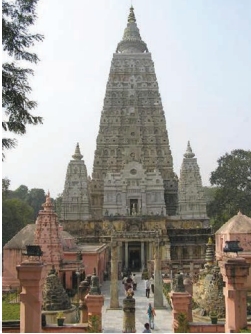
Mahabodhi Temple, Bodhgaya - A UNESCO World Heritage site, this sacred temple marks the spot where Lord Buddha attained enlightenment under the Bodhi tree, symbolizing ultimate spiritual achievement and historical importance. - (i) The temple's core, irreplaceable significance stems from Bodhgaya being the primary Buddhist site where Siddhartha Gautama attained supreme enlightenment, making the Mahabodhi Temple an irreplaceable cultural and religious landmark, especially emphasized by the artistic patronage of the Pala period.
- (ii) Architecturally, the Mahabodhi Temple presents a fascinating and unique blend of Northern and Southern temple building traditions, combining key elements of both Nagara (Northern Indian) and Dravida (Southern Indian) styles in its towering elevation.
- (iii) While its generally vertical, narrow shaft is reminiscent of the curvilinear Nagara temple form, its distinct non-curving, straight rise upward bears a strong resemblance to the traditional, stepped Dravida Vimana design, resulting in a distinctive and powerful mixed style structure.
Nalanda University: The Grandeur of an Ancient Monastic University
The ancient seat of learning, Nalanda was far more than a physical structure; it was an unparalleled intellectual powerhouse, an ancient Mahavihara renowned throughout the Asian world for its profound scholarship, architectural sophistication, and its role as a monumental beacon of Buddhist philosophical learning.
Nalanda's Architectural Layout and the Evolution of Sculptural Art
The meticulously organized ruins of Nalanda reveal a precisely planned complex of monasteries (viharas) and temples (chaityas), showcasing the high level of architectural skill achieved by the Gupta and Pala artisans. Furthermore, its prolific artistic output deeply influenced the aesthetic trends across the region and beyond, marking a critical, transformative phase in Buddhist sculptural art.
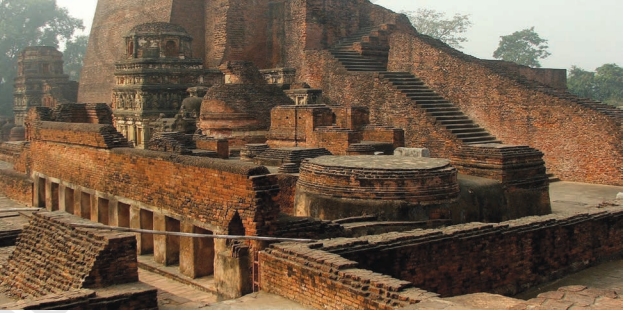
Nalanda University - The ancient seat of learning, Nalanda stands as a symbol of intellectual brilliance and architectural grandeur, a testament to the patronage of monarchs like Kumargupta I in Indian history. - (i) Nalanda, originally founded as a mahavihara by the Gupta ruler Kumargupta I in the , received continuous and substantial royal patronage, allowing it to flourish under subsequent monarchs and become a globally recognized, vibrant hub for many centuries.
- (ii) The institution's academic fame was truly global; it attracted countless monks and scholars from distant lands including China, Tibet, Sri Lanka, Thailand, and Burma, who, upon their return, disseminated Nalanda's distinctive artistic styles, philosophical teachings, and its vast collections of manuscripts across the entirety of Asia.
- (iii) The distinctive sculptural art of Nalanda evolved significantly from the earlier, refined and classical styles of Gupta Sarnath, developing into highly detailed, three-dimensional depictions characterized by the expressive regional traditions of Bihar and Bengal.
- (iv) Towards the , coinciding with regional political shifts, Nalanda increasingly focused its intellectual and artistic energy towards Vajrayana Buddhism (the Diamond Vehicle), cementing its importance as a crucial center for the study and practice of tantric practices and deities.
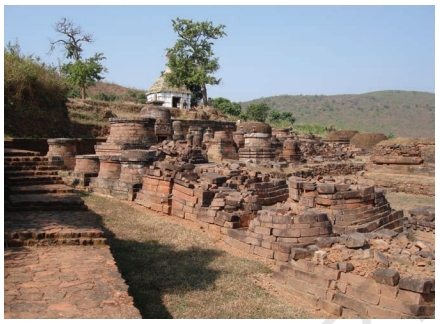
Excavated Site of Nalanda - Archaeological excavations provide invaluable insight into the sheer scale and architectural legacy of the university, showcasing the residential, temple, and academic complexes that once housed thousands.
Sirpur and Other Regional Buddhist Architectural Centers
The widespread influence of the Buddhist faith manifested in distinctive regional architectural styles across various parts of India, notably in central and eastern regions like Chhattisgarh and Odisha, as well as crucial coastal trading hubs that facilitated cultural exchange.
Sirpur, Odisha, and Nagapattinam: Regional Expressions and Maritime Links
These geographically dispersed sites demonstrate the widespread influence of the established monastic centers like Nalanda while also developing their own unique regional flair, often linked by ancient trade routes, major rivers, and crucial maritime connections that supported cultural diffusion.

Lakshmana Temple, Sirpur - This temple, though Hindu, is located in the key Sirpur region and showcases the exceptional architectural and sculptural finesse prevalent among ancient Indian artisans of the era, reflecting a shared artistic environment. - (i) Sirpur in Chhattisgarh, along with major Buddhist sites in Odisha—specifically Lalitagiri, Vajragiri, and Ratnagiri (often termed the Diamond Triangle of Odisha)—exhibit a clear evolution in Buddhist architectural design, frequently mirroring or being influenced by the grand monastic style established at Nalanda and other centers.
- (ii) The strategically important coastal town of Nagapattinam in Tamil Nadu functioned as a key and thriving Buddhist center, largely owing to its vigorous participation in essential maritime trade, especially with Sri Lanka and Southeast Asia during the flourishing rule of the powerful Chola dynasty.
Jain Architecture: The Splendor of Pilgrimage Sites and Marble Artistry
The tenets of Jainism inspired the construction of magnificent temples and sacred sites (known as tirthas) across the length and breadth of India, characterized by their meticulous planning, incredibly intricate sculptural work, and the celebrated, luminous use of lustrous white marble for ultimate spiritual purity.
Jain Architectural Developments: From Bihar to Karnataka's Monoliths and Rajasthan's Carvings
The unwavering dedication of Jain patrons and skilled builders led to the creation of enduring masterpieces that serve as important hubs for pilgrimage and artistic study, ranging from massive monolithic statues embodying asceticism to the most delicate, lace-like marble carvings showcasing unparalleled craftsmanship.
- (i) Jains were exceptionally prolific builders, establishing temples throughout India, with the very oldest pilgrimage sites traditionally located in the eastern state of Bihar, including Parasnath Hill (Sammed Shikharji).
- (ii) Other extremely notable sites that showcase centuries of Jain architectural evolution and regional styles include the extensive cave temples at Ellora, the early structural temples at Aihole, and major temple complexes at Deogarh, Khajuraho, Chanderi, and Gwalior, often coexisting with Hindu structures.
- (iii) Sravana Belagola in Karnataka is globally famous for housing the world's tallest monolithic statue, the towering Gomateshwara (Lord Bahubali), a masterpiece commissioned by the powerful minister Camundaraya of the Ganga dynasty in the .
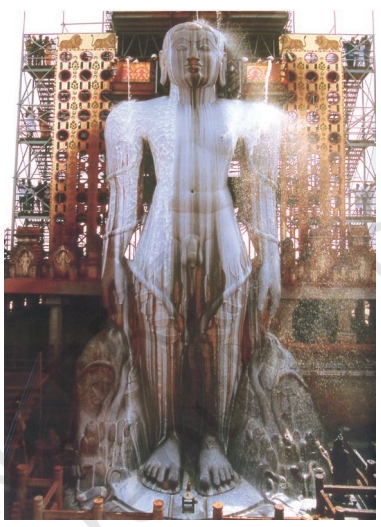
Lord Bahubali Gomateshwara, Karnataka - A towering monolithic statue symbolizing profound peace and spiritual transcendence (kayotsarga), one of the most important Jain sculptures and pilgrimage sites in Southern India. - (iv) The renowned Jain temples at Mount Abu in Rajasthan, particularly those constructed by Vimal Shah (known as the Dilwara Temples), are universally celebrated for their deceptive exterior simplicity which contrasts sharply with the incredibly richly decorated, intricate interiors carved entirely from pristine white marble.
- (v) Palitana in Gujarat stands as one of the most sacred Jain sites (tirthas), distinguished by hundreds of temples clustered atop the Shatrunjay hills, making it a major, awe-inspiring pilgrimage destination and a unique example of a temple-city complex.
Materials and Surviving Art Forms: A Glimpse into Artistic Practices
The architectural and artistic output of this critical period relied heavily on durable, local materials, ensuring the survival of key stone and metal works while simultaneously providing evidence of broader, though less-preserved, artistic traditions like painting and wood carving.
- (i) The primary materials used for permanent structures and sculptures were resilient Stone, terracotta, and the impressive, highly developed bronze casting tradition, particularly strong in the East; sadly, precious metal sculptures made of silver and gold were often melted down and reused over centuries.
- (ii) Works crafted from organic materials like wood and ivory have rarely survived the ravages of climate, insects, and time, and painted works are also scarce due to the inherent challenges in preserving pigments across centuries of harsh conditions.
- (iii) The highly sophisticated murals, or wall paintings, found surviving in a few religious buildings (like the spectacular examples in the Ajanta Caves) serve as invaluable evidence of the truly rich and elaborate painting traditions that once adorned many religious and secular structures of this era.
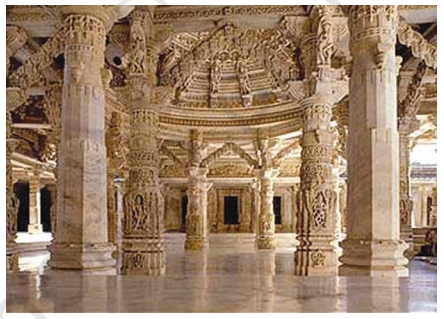
Dilwara Jain Temples, Mount Abu - Known for their breathtaking, exquisite marble carvings on ceilings and pillars, these temples are a definitive, prime example of the pinnacle of Jain architectural artistry and craftsmanship.
⚡ Quick Revision Capsule: Key Buddhist & Jain Architectural Sites
A quick comparison of prominent Buddhist and Jain heritage sites, their geographical locations, main dynastic patrons, and unique architectural highlights:
| Site & Region | Patrons & Era | Architectural & Artistic Highlights |
|---|---|---|
| Mahabodhi Temple (Bodhgaya, Bihar) | Pala Dynasty & early rulers () | Hybrid elevation combining Nagara verticality with straight Dravida Vimana profile. |
| Nalanda Mahavihara (Bihar) | Gupta Empire (Kumargupta I) & Pala Rulers | Vast monastic complex with viharas, chaityas, and refined Pala bronze sculptures. |
| Sravana Belagola (Karnataka) | Ganga Dynasty (Camundaraya, ) | World's tallest monolithic statue of Gomateshwara in kayotsarga posture. |
| Dilwara Temples (Mount Abu, Rajasthan) | Solanki/Chalukya Ministers (Vimal Shah) | Plain exterior structures housing exceptionally intricate, carved white marble interiors. |
| Palitana Temples (Gujarat) | Multiple Jain Patrons & Guilds | Sacred mountain tirtha featuring hundreds of shrines forming a temple-city complex. |
📝 Summary
This comprehensive overview highlights the remarkable evolution of Buddhist and Jain temple architecture from the politically dynamic through the . The study of key sites such as the synthesis-driven Mahabodhi Temple, the academic metropolis of Nalanda, the monolithic wonder of Sravana Belagola, and the marble delicacy of the Dilwara Temples emphasizes the complex interweaving of religious patronage, trade networks, and artistic innovation across ancient India.
🚀 Quick Revision Points
Essential facts to review before examinations:
- (i) The Mahabodhi Temple combines Northern Nagara and Southern Dravida style features.
- (ii) Nalanda University was established by Kumargupta I in the and flourished as a global Buddhist center.
- (iii) The Gomateshwara monolith at Sravana Belagola was sculpted under the Ganga dynasty in the .
- (iv) The Dilwara Temples on Mount Abu showcase magnificent white marble ceiling and pillar carvings.
- 💡 Exam Tip: When answering exam questions on medieval religious architecture, always highlight how trade routes (like Nagapattinam's sea lanes) and dynastic support (like Pala and Ganga rulers) directly influenced building styles.
❓ Frequently Asked Questions (FAQ)
Q1: What makes the architecture of the Mahabodhi Temple unique?
A1: It features a blend of Nagara and Dravida styles, combining a tall vertical shaft with straight, non-curving steps similar to a Dravida Vimana.Q2: Who founded Nalanda University and which dynasty supported its art?
A2: It was founded by the Gupta king Kumargupta I in the and received extensive patronage from the Pala dynasty, which advanced bronze and stone sculptural art.Q3: What are the key features of the Dilwara Temples at Mount Abu?
A3: Built primarily during the Solanki era with patronage from Vimal Shah, they are famous for plain stone exteriors contrasted with extraordinarily detailed white marble ceiling carvings inside.
Historical Relevance of Buddhist and Jain Architecture for Students
This study of Buddhist and Jain temple architecture is fundamentally important for students preparing for history, art and culture, and competitive civil service examinations. Mastering the structural details of sites like Nalanda, Bodhgaya, and Sravana Belagola provides indispensable insights into ancient Indian cultural networks and artistic heritage.