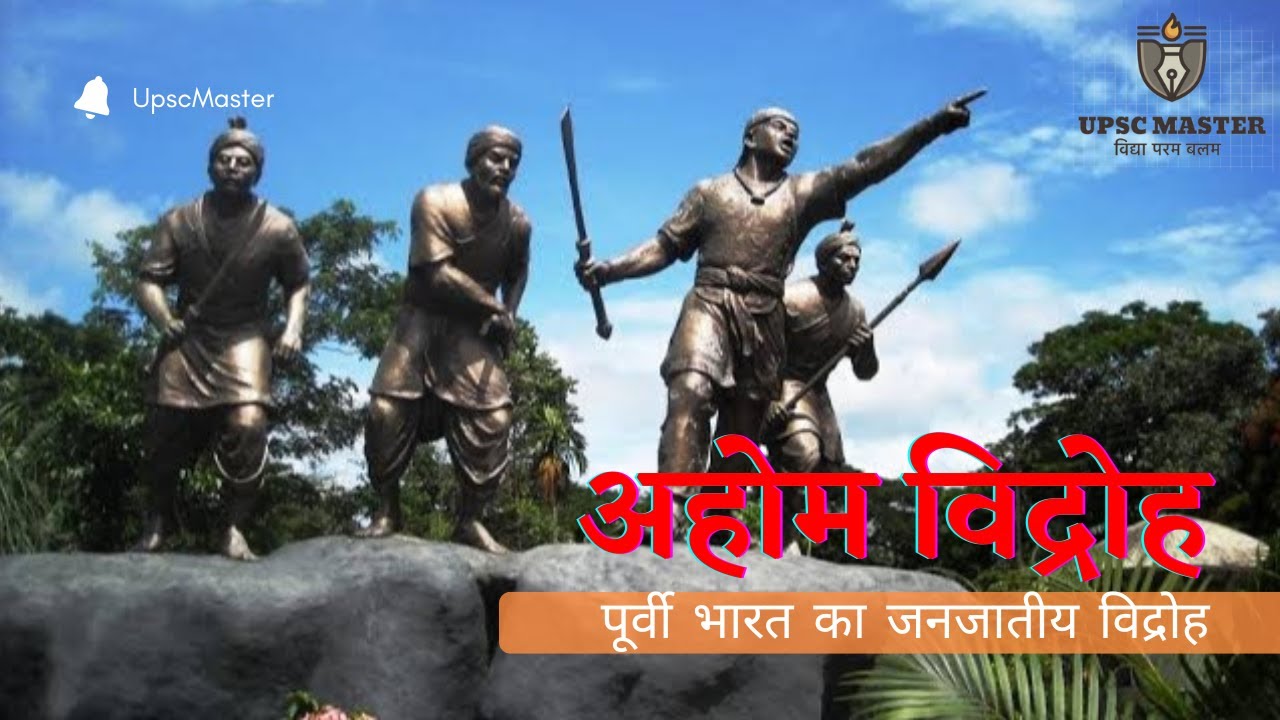
The Ahom Revolt of 1828 stands as a pivotal and significant episode in the timeline of Assamese history, marking an early and determined resistance against the burgeoning British colonial expansion in Northeast India. Following the conclusion of the First Burma War (), the subsequent actions of the British, particularly their policies of annexation, deeply unsettled the region and sparked widespread unrest. This movement highlights the deep-seated Ahom people’s struggle for sovereignty and their desire to restore traditional rule, offering crucial insights into the early phases of nationalist sentiments for students preparing for exams on Indian freedom movements.
🎯 In this chapter, you will understand:
- The primary causes and broken promises that triggered the Ahom Revolt of .
- The key leadership of Gomdhar Konwar and his key allies near Jorhat.
- The British military response and their conciliatory strategy involving Maharaja Purandar Singh Narendra.
- The long-term impact of this uprising on British policy in Assam and its relevance to anti-colonial history.
💡 Why this topic matters: It highlights the earliest organized resistance against British rule in Assam immediately after the First Burma War, setting an important historical precedent for future anti-colonial movements.
🧠 Core Idea: The revolt was sparked by the British breaking their pledge to leave Assam, prompting the local Ahom nobility to unite under Prince Gomdhar Konwar to reclaim their traditional sovereignty.
Ahom Revolt 1828: Assam’s People’s Determined Resistance Against British Annexation Policies
The Ahom Revolt was fundamentally triggered by the British failure to uphold their solemn commitments made during the conflict with the Burmese, leading to an immediate pushback against foreign control.
The Ahom people, who had governed the region for centuries, were deeply alarmed by the British presence and their apparent intention to permanently occupy the land instead of restoring the previous administrative structure.
- (i) The primary flashpoint occurred after the conclusion of the First Burma War (), where the British, contrary to their initial assurances of a temporary presence, chose not to withdraw from Assam.
- (ii) Instead of retreating, the British administration decisively moved toward the full annexation of Ahom territories, integrating them into their expanding colonial domain.
- (iii) This profound sense of betrayal and the direct threat to their self-governance ignited widespread anger among the Ahom populace, unifying them in their goal to reclaim their lost sovereignty and traditional governing authority.
Catalysts and Grievances Sparking the Ahom Revolt
The revolt was fueled by immediate administrative overhauls and the broken promises that followed the cessation of hostilities with the Burmese forces.

British Betrayal of the Withdrawal Promise
The single greatest catalyst for the revolt was the broken agreement made by the British, who had initially entered Assam only to drive out the invading Burmese forces but then chose to stay, setting the stage for prolonged conflict.
- (i) The Treaty of Yandaboo had effectively removed the Burmese threat, but it left the question of the future of the Ahom kingdom unanswered, which the British quickly exploited.
- (ii) The installation of a foreign administrative system was seen as a direct usurpation of the power of the Ahom monarch and the traditional nobility.
Leadership, Emergence, and the Declaration of Ahom Sovereignty
The resistance movement quickly found its figurehead in a member of the royal lineage, who rallied the disaffected noblemen and common people under the banner of restoring Ahom self-rule.
- (a) The uprising was courageously spearheaded by Gomdhar Konwar, a prince of the Ahom royal family, who provided the legitimate claim needed for the mass movement.
- (b) He was supported by influential and powerful regional allies, notably Dhanjoy Bongohain and Jairam Khargharia Phukan, who mobilized key resources and manpower.
- (c) The rebels successfully assembled their forces near the historic city of Jorhat, where Gomdhar Konwar was formally declared their king, an act symbolizing their direct and profound defiance against the imposition of British authority.
Suppression and Partial Conciliation: Outcome of the Ahom Revolt
While the revolt was ultimately put down by the superior British forces, the administration chose a pragmatic approach, realizing that total military suppression would only prolong the resistance.
British Strategic Response and Conciliation Policy
Instead of relying solely on force, the British command employed a careful conciliatory strategy aimed at quelling the rebellion and de-escalating the broader political tensions across the region.
- (i) The British realized that a total military crackdown risked turning the regional unrest into a prolonged, costly guerrilla war, and thus sought a political solution.
- (ii) To partially address the core political grievances of the Assamese people and pacify the widespread resistance, they made a significant concession.
- (iii) This key decision involved the strategic restoration of a substantial portion of the Upper Ahom kingdom back to Maharaja Purandar Singh Narendra, effectively installing a subsidiary local ruler.
Long-Term Impact on British Policy in Assam
The Ahom Revolt demonstrated to the British the power of local sentiment and the high cost of total annexation, leading to a more cautious approach in the subsequent decades.
- (i) Acknowledgement of Ahom Legitimacy: The move to restore Purandar Singh was an implicit acknowledgment of the legitimate historical right of the Ahom rulers over their land.
- (ii) Precedent for Future Resistance: The revolt, though suppressed, set an important precedent for future movements and is a key topic for students of colonial administration and governance.
Significance and Relevance for Students: Analyzing the Ahom Revolt (1828)
The Ahom Revolt of 1828 is a critical milestone, demonstrating that local rulers and the populace were ready to challenge British territorial ambitions immediately following the military withdrawal of the Burmese, highlighting the early nature of organized anti-colonial resistance in the region. The leadership of Gomdhar Konwar and the eventual partial restoration of the kingdom to Maharaja Purandar Singh Narendra provide an excellent case study on the British policy of subsidiary alliances versus direct annexation. It is essential for students to study this event to understand the diverse forms of resistance that paved the way for the broader Indian freedom struggle against British rule.
⚡ Quick Revision Capsule: Ahom Revolt 1828
Key highlights and facts regarding the 1828 Ahom Revolt summarized for exam preparation:
| Aspect | Details & Key Terms | Significance |
|---|---|---|
| Timeline | (Following First Burma War) | Occurred immediately after the British failed to leave Assam as promised. |
| Primary Cause | British violation of their promise to withdraw and attempt to annex Ahom territories | Direct threat to local sovereignty and traditional governance. |
| Key Leaders | Gomdhar Konwar, Dhanjoy Bongohain, Jairam Khargharia Phukan | Mobilized noblemen and commoners; declared Gomdhar Konwar as King near Jorhat. |
| British Response | Military suppression combined with a conciliatory political strategy | Avoided prolonged guerrilla warfare by negotiating with local elites. |
| Outcome | Restoration of Upper Assam to Maharaja Purandar Singh Narendra | Established a subsidiary ruler while acknowledging traditional Ahom legitimacy. |
📝 Summary
The Ahom Revolt of was an early anti-colonial uprising triggered when the British broke their pledge to leave Assam following the First Burma War (). Led by Prince Gomdhar Konwar along with prominent nobles like Dhanjoy Bongohain and Jairam Khargharia Phukan, the rebels declared independence near Jorhat. Although British forces put down the rebellion, the British adopted a conciliatory policy to prevent ongoing resistance, ultimately restoring Upper Assam to Maharaja Purandar Singh Narendra as a subsidiary ruler.
🚀 Quick Revision Points
Essential facts to review before examinations:
- (i) The uprising started in due to British refusal to withdraw from Assam after the Treaty of Yandaboo.
- (ii) Prince Gomdhar Konwar was proclaimed King of the Ahom forces near Jorhat.
- (iii) Key allies included noblemen Dhanjoy Bongohain and Jairam Khargharia Phukan.
- (iv) British forces pacified the region by handing Upper Assam to Maharaja Purandar Singh Narendra.
- 💡 Exam Tip: Focus on the cause-and-effect relationship between the First Burma War (1824–26), the Treaty of Yandaboo, Gomdhar Konwar's revolt, and the ultimate restoration of Purandar Singh in Upper Assam.
❓ Frequently Asked Questions (FAQ)
Q1: What was the main cause of the Ahom Revolt of 1828?
A1: The primary trigger was the British betrayal of their promise to withdraw from Assam after defeating the Burmese in the First Burma War, choosing instead to annex Ahom lands.Q2: Who led the Ahom Revolt against the British?
A2: The revolt was led by Prince Gomdhar Konwar, supported by key leaders like Dhanjoy Bongohain and Jairam Khargharia Phukan.Q3: What was the outcome of the Ahom Revolt?
A3: Although the revolt was suppressed, the British adopted a political conciliation strategy, handing back control of Upper Assam to Maharaja Purandar Singh Narendra as a local ruler.