The Gupta Administration, flourishing in northern India between c. 320 CE and 550 CE, stands as a critical historical watershed in ancient Indian political history. This influential era marked a definitive departure from the rigidly centralized administrative model pioneered by the earlier Mauryan Empire, transitioning instead into a more decentralized, feudatory-based system. The inner workings of this empire are extensively documented through primary sources, including the famous travel accounts of the Chinese Buddhist pilgrim Fa-Hien and a wealth of royal Gupta inscriptions engraved on stone pillars and copper plates. These sources reveal a highly sophisticated governance model characterized by a benevolent monarchy, grand ceremonial titles, and autonomous local self-government bodies. Gaining a thorough command of these administrative and fiscal precedents is absolutely vital for students preparing for the UPSC civil services, competitive history examinations, and general ancient Indian history studies.
In this chapter, you will understand:
- The structural evolutionary shift from highly centralized Mauryan control to decentralized early medieval politics.
- The eyewitness accounts of Fa-Hien regarding public freedom, lenient judicial punishments, and societal security.
- The nature of divine kingship, majestic royal designations, and the functional division of civil-military councils.
- The breakdown of provincial hierarchy (Bhuktis) down to districts (Vishayas) and autonomous village assemblies (Gramikas).
Why this topic matters: Analyzing the structural dynamics of this imperial era helps students understand the evolution of land rights, fiscal systems, and administrative patterns that directly shaped later early medieval Indian dynasties, making it a heavily tested area in core history syllabi.
Core Idea: The Gupta state successfully blended absolute imperial rule with localized autonomy. By delegating authority to provincial governors, district committees, and merchant guilds, the emperors maintained vast territorial control through structured feudatory allegiances. Land grants and hereditary offices gradually paved the way for institutionalized decentralization across the subcontinent.
Evolution of Decentralized Polity
The administrative evolution during the post-Mauryan era witnessed a gradual yet deep shift away from tight imperial centralization toward a shared power model, dictated by changing political and economic dynamics.
The Weakening of Monolithic Imperial Control
The Gupta administration skillfully blended inherited centralized traditions with emerging local forces, establishing the core administrative template for early medieval India.
- Erosion of Centralization: A defining feature of this era was the gradual erosion of direct central monitoring, creating a sharp contrast with the all-powerful bureaucratic network of the older Mauryan state.
- Emergence of Feudatories: Predecessor dynasties like the Satavahanas and the Kushans had already initiated feudatory relations with minor, subordinate chiefs, a practice that the Gupta rulers embraced and vastly expanded.
The Impact of Royal Land Donations
The rapid proliferation of tax-free land-grants to religious institutions and scholars created distinct administrative zones in rural frontiers.
- These land donations transferred fiscal collection and judicial rights directly to the beneficiaries, bypassing central tax agents.
- Local populations within these grants looked to these new landlords for daily governance rather than the distant royal court.
- Powerful urban commercial hubs in northern India retained extensive local liberties, where influential guilds of traders even enjoyed the sovereign privilege of issuing coins.
Fa-Hien's Historical Records
The travel records compiled by the Chinese Buddhist pilgrim Fa-Hien, combined with diverse Gupta inscriptions, serve as primary historical pillars illustrating the mild, benevolent, and highly effective nature of the Gupta government.

- Fa-Hien observed that citizens did not have to register their households or appear before official magistrates to travel freely.
Administrative Efficiency and Mildness
According to these primary texts, the imperial administration focused heavily on civil peace and minimal state interference in the daily business of ordinary families.
- Lenient Judiciary: The legal penal system was notably not severe, relying primarily on fines scaled to the offense, with capital punishment or physical mutilation being incredibly rare.
- Absence of Espionage: Unlike the comprehensive spy networks described in Mauryan political treaties, Fa-Hien noted a distinct absence of a heavy spy system, indicating stable public peace and trust.
- Safety and Prosperity: State management was highly efficient, ensuring that main highways and roads were kept safe for travelers, successfully reducing crime rates and encouraging long-distance trade.
Centralized Monarchy and High Titles
At the apex of the central administration stood a system of benevolent monarchy, where the King functioned as the ultimate commander, lead legislator, and supreme judge of the state machinery.
- The state popularized the theory of the divinity of kings, exalting the ruler's prestige to secure public compliance.
Ministers and Bureaucratic Machinery
To assert their widespread geopolitical supremacy, Gupta rulers cast aside the modest title of raja, adopting grand designations such as maharajadhiraja, 'Raja-dhiraja', and 'Samrat'.
Gupta gold coins showcasing the emperor's royal prestige and high titles like Maharajadhiraja. - King as Deity-Equal: Inscriptions like the famous Allahabad Pillar inscription praise monarchs like Samudragupta as being equal to the gods of the Hindu pantheon, comparing them to "Dhanda" (Kubera), "Varuna", "Indra", and "Antaka" (Yama).
- Source of Power: Great emperors like Skandagupta and Chandragupta-II routinely personally led their armies into critical battles, proving that their divine authority was backed by military command.
- Checks on Despotism: Despite holding vast theoretical power, kings were bound by customary Dharma and shared practical control with a Council of Ministers ("Mantri-Parishad") and local town elders.
Quick Revision Capsule: Gupta Administrative Offices
A quick summary guide mapping the primary official designations and key duties within the empire:
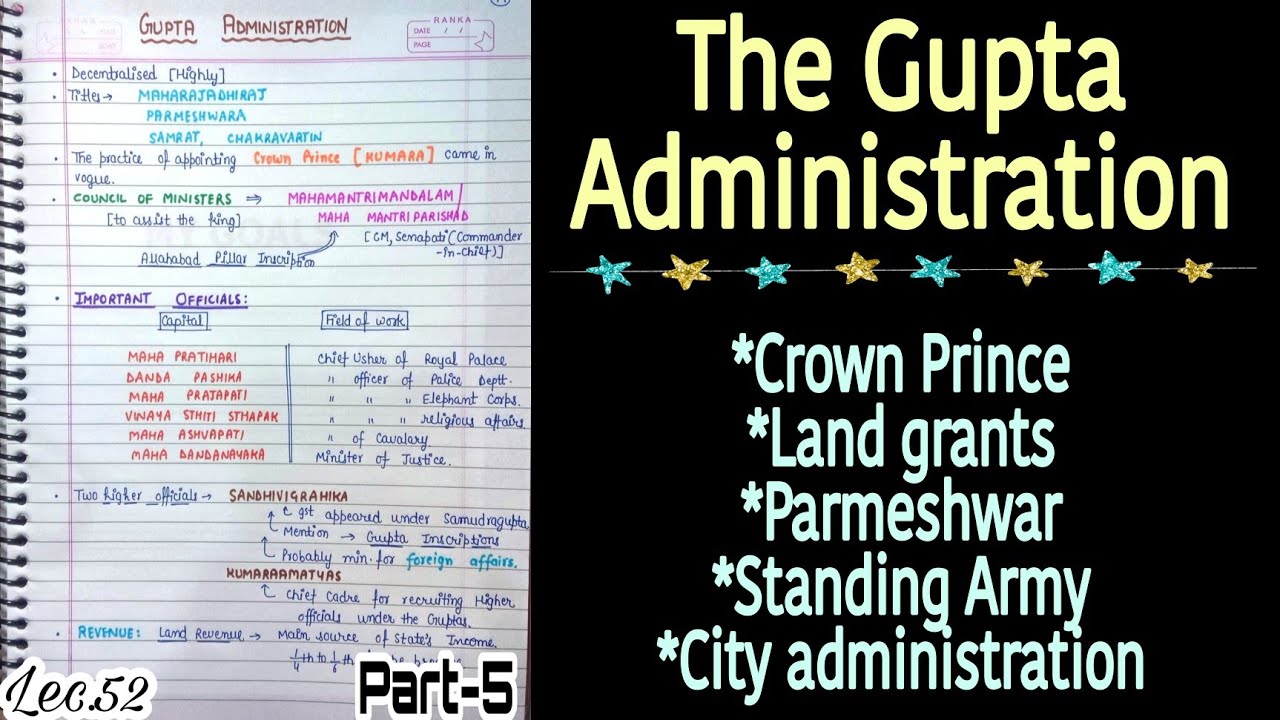
| Official Designation | Primary Department / Realm | Core Administrative Responsibility |
|---|---|---|
| Mantri Mukhya | Central Advisory Council | Functions as the Chief Minister assisting the monarch on state policy. |
| Mahasandhi Vigrahaka | Foreign Affairs & Diplomacy | Manages declarations of war, peace treaties, and relations with feudatories. |
| Mahabaladhikrita | Imperial Armed Forces | Serves as the supreme commander overseeing infantry, cavalry, and elephants. |
| Uparika | Provincial Governance (Bhukti) | Acts as the provincial governor, frequently appointed from royal princes. |
| Vishayapati | District Administration | Manages district affairs, land sales, and local urban councils. |
Summary
The historical footprint of the Gupta administration centers on its ability to build a vast empire without creating an oppressive central bureaucracy. By dividing the vast realm into structured provinces (Bhuktis) and districts (Vishayas), and trusting local village heads (Gramikas) with immediate civil tasks, they achieved long-term systemic stability. The regular use of grand imperial titles highlighted their supreme political standing, but the expansion of land donations and reliance on feudatory militaries created a highly decentralized structure. This unique administrative framework served as the functional bridge between ancient imperial styles and the decentralized kingdoms that defined medieval India.
Quick Revision Points
Essential takeaways for history examination preparation:
- (i) The transition from Mauryan centralization to decentralized feudal structures accelerated under the Guptas.
- (ii) Primary records by Fa-Hien confirm a lenient penal code relying heavily on compensatory fines.
- (iii) Administrative posts like the Kumaramatya became increasingly hereditary, anchoring power in specific elite families.
- (iv) Land revenue from the agricultural classes remained the chief economic pillar sustaining the imperial treasury.
- Exam Tip: Pay close attention to the specific operational titles like Mahasandhi Vigrahaka and the hierarchy of territorial divisions (Bhukti down to Vishaya). Questions in civil services exams frequently test these exact technical administrative terms.
Frequently Asked Questions (FAQ)
Q1: What was the primary difference between the Mauryan and Gupta administrative structures?
A1: The Mauryan system relied on a highly centralized network controlled directly by the crown's bureaucracy. In contrast, the Gupta model was decentralized, relying heavily on autonomous regional feudatories, land-grant recipients, and localized city councils.Q2: What role did the Uparikas play in provincial governance?
A2: An Uparika served as the head governor of a major province known as a Bhukti. They were directly chosen by the king, often from among the royal princes, and held wide civil, revenue, and military authority within their territories.Q3: How was land revenue calculated and paid during the Gupta Era?
A3: Land revenue, including the Uparika tax, was the primary income source for the state. The crown typically claimed about one-sixth of the total agricultural produce, which could be collected in kind (grains) or cash (gold coins).