The story of Mahmud of Ghazni begins in Ghazni, a strategic city located in present-day Afghanistan. From here, he inherited and aggressively expanded the emerging Ghaznavid Empire. The historical foundations of his dominion were laid down by his father, a former warrior-slave, setting a dramatic stage for Mahmud's subsequent military breakthroughs and deeply controversial campaigns across the Indian Subcontinent. Understanding this era is vital because it marked a major shift in the geopolitical and cultural landscape of South and Central Asia.
In this chapter, you will understand:
- The origins of the Ghaznavid Empire and Mahmud’s ascent to the throne.
- The key strategic, economic, and religious drivers behind the seventeen invasions of Hindustan.
- The major military milestones, including the collapse of the Hindushahi Kingdom and the raid on Somnath.
- The complex cultural, political, and historical legacy left by the first Sultan.
Why this topic matters: This period explores how political fragmentation in the subcontinent opened paths for external conquest, establishing structural patterns that reshaped regional architecture, wealth redistribution, and religious histories for centuries.
Core Idea:Mahmud of Ghazni leveraged a centralized military machine to launch repeated, highly coordinated raids into North-Western India between 1000 A.D. and 1026 A.D. While his campaigns focused heavily on extracting vast wealth from affluent temple centers to fund his Central Asian imperial goals, they also triggered intense historical debates regarding his economic vs. religious motivations. Beyond the battlefield, his capital became a major center for arts and learning before his death in 1030 A.D.
Mahmud of Ghazni: Foundations of the Empire
The rise of the Ghaznavid power state demonstrates how quickly political vacuums could be filled in Central Asia during the twilight of classical dynasties. Mahmud of Ghazni, born in 971 A.D. with the full name Dawlah Abdul-Qasim Mahmud-bin-Sabuktegin, hailed from the city of Ghazni, which was strategically located in South-East Afghanistan.
The Legacy of Sabuktegin
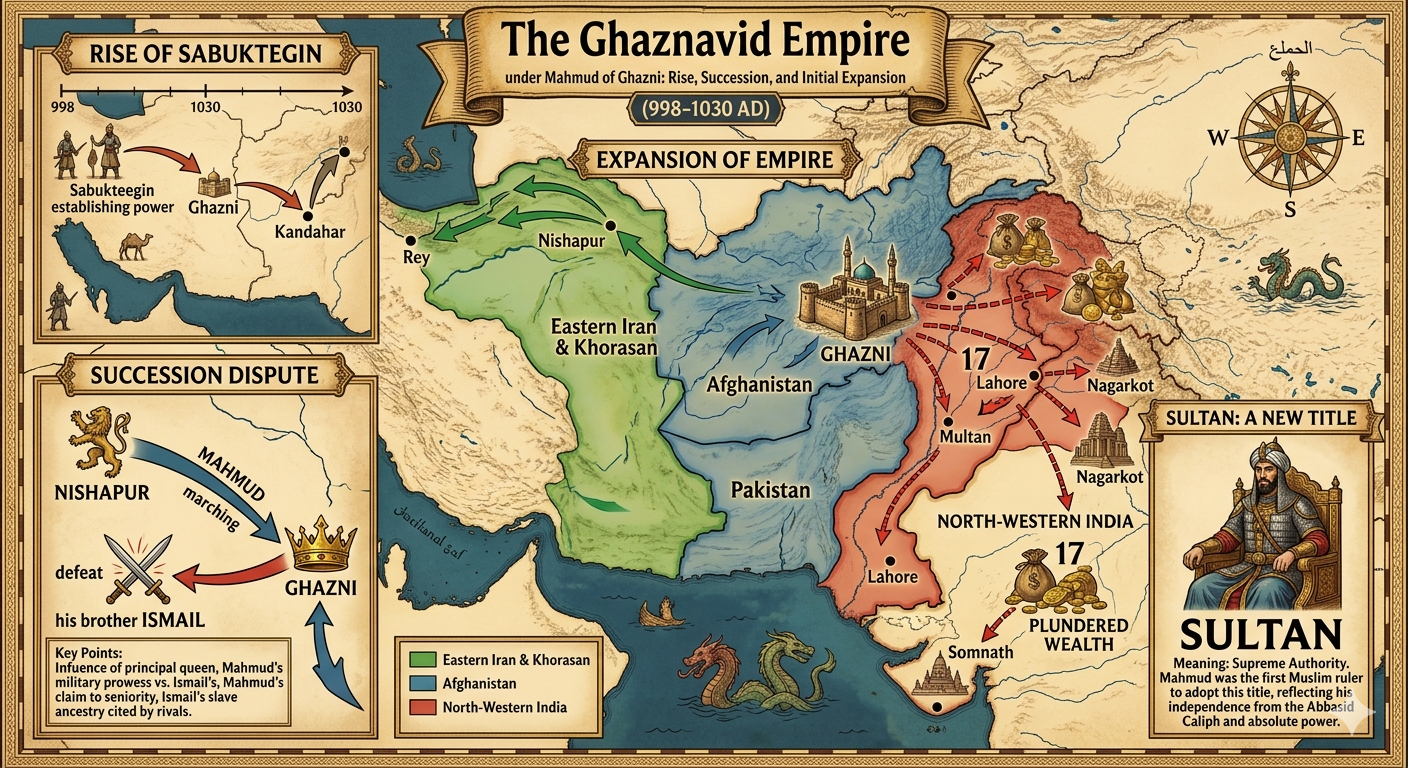
His father, Abu Mansur Sabuktegin, was initially a Mamluk warrior-slave who managed to establish autonomous control over Ghazni in 977 A.D. by capitalizing directly on the visible decline of the Samanid dynasty of Bukhara (located in modern Uzbekistan). Sabuktegin successfully expanded his initial territory, incorporating major cities like Kandahar, which solidified the core foundations of the emerging Ghaznavid Empire.
- The territorial reach of the empire under Mahmud would soon overshadow these initial boundaries through systematic militarism.
Mahmud of Ghazni: Rise to Power and Conflict for the Throne (997-998 A.D.)
Despite being the eldest son, Mahmud’s succession to the leadership of the empire was openly contested, leading to a swift and decisive internal power struggle that secured his absolute control over the burgeoning domain.
The Contested Succession of the Ghaznavid Empire
The transition of authority following Sabuktegin's death was far from peaceful, as traditional preference was initially given to his younger son, Ismail, leading to a crucial fratricidal conflict that defined Mahmud's early political trajectory.
- (i) Mahmud, though the eldest son, was overlooked for succession in favor of his younger brother, Ismail, due to the heavy influence of the principal queen and the fact that Ismail lacked the slave ancestry from both parental sides that Mahmud possessed.
- (ii) Upon the death of Sabuktegin in 997 A.D., Ismail ascended the throne in Ghazni, but Mahmud, who was stationed in Nishapur (present-day Iran), immediately challenged this nomination.
The Victory of 998 A.D.
In 998 A.D., Mahmud marched directly on Ghazni, decisively defeating his brother's forces in a swift military campaign, seizing control of the throne, and subsequently imprisoning Ismail for life; thus beginning his formal thirty-two-year reign from 998 A.D. to 1030 A.D.
- Milestone 1: Mobilization from Nishapur to challenge the succession.
- Milestone 2: Decisive tactical victory outside the walls of Ghazni.
- Milestone 3: Deposition and lifelong confinement of Ismail.
- Milestone 4: Consolidation of supreme military command across the realm.
Assumption of the Title 'Sultan' and Imperial Expansion
Mahmud's geopolitical ambitions extended far beyond regional consolidation, as he rapidly transformed his domain into a formidable Central Asian empire and adopted the powerful title of Sultan.
- (a) During his reign, Mahmud of Ghazni aggressively expanded his borders to include vast territories, notably large portions of Afghanistan, Eastern Iran, Pakistan, and strategically vital areas of North-Western India.
- (b) Maintaining a strong symbolic connection to the Caliph, Mahmud was the first ruler in Indian history to adopt the prestigious title of Sultan, meaning authority, which served as a bold assertion of his supreme military sovereignty.
- (c) He became famous for launching seventeen military invasions into the Indian subcontinent between 1000 A.D. and 1026 A.D., primarily driven by the goal of plundering the immense wealth of temples and rich cities.
Causes and Debates on Mahmud's Indian Conquests (1000-1026 A.D.)
The repeated incursions launched by the Ghaznavids into Hindustan were fueled by an advantageous mix of strategic openings, economic temptation, and deeply debated religious justifications, making his core motives a complex subject for modern historians.
Strategic Vulnerability and Economic Drivers for Plunder
The fabulous wealth and deep political fragmentation of India, combined with the convenient geographical proximity of his base in Afghanistan, made the subcontinent an irresistible target for Mahmud's expeditions.
- (i) Indian Prosperity and Climate: Until the rise of Western economic powers, India was globally renowned for its fabulous wealth and agricultural prosperity, making it a highly tempting target for external invaders seeking rapid riches.
- (ii) Geographical Proximity and Access: The established mountain passes and routes connecting Mahmud's home bases to North-Western India provided straightforward, seasonal access for his highly mobile cavalry forces.
- (iii) Political Disunity: The ongoing political fragmentation of northern India into separate, warring kingdoms—which completely lacked a unified defensive alliance—made the region exceptionally vulnerable to organized external invasions.

Historical Debate: Economic Gain vs. Religious Zeal
Modern scholars continue to grapple with the primary drivers behind the Sultan's brutal campaigns, balancing his clear material needs with his self-styled role as an iconoclast.
- (a) Economic Motives: Many historians argue that his ultimate objective was simple economic gain—specifically, the plundering of Indian temple wealth to directly finance his vast imperial designs and standing armies in Central Asia. They highlight that he made no real attempts to permanently settle or administer the vast inner territories he invaded, save for Punjab, which was annexed to serve as a vital, permanent strategic base.
- (b) Religious Motives: Other scholars highlight his explicit religious agenda, pointing to the systematic destruction of numerous sacred Hindu temples and his frequent refusal of massive ransoms offered by locals to spare their idols. Throughout contemporary records, he was celebrated as an iconoclast who demolished images to earn religious merit within the orthodox world.
- (c) The Middle View (Romila Thapar): Noted historian Romila Thapar suggests a balanced, pragmatic view: Mahmud required massive, immediate liquid funds to support his ongoing military struggles in Central Asia. Because Indian temples functioned as major economic repositories holding the highest concentrations of gold and wealth, they naturally became his prime targets. She also notes that his campaigns targeted both Hindus and fellow Muslim Shia Ismailis, highlighting a distinctly political and sectarian dimension to his warfare.
Quick Revision Capsule: Invasions and Motives
A structured breakdown of the foundational elements, drivers, and structural targets of the Ghaznavid expeditions:
| Campaign Element | Strategy & Mechanism | Core Target & Objective |
|---|---|---|
| Empire Building | Centralized cavalry and tactical speed | Funding Central Asian expansion and capital upkeep |
| Target Selection | Exploiting political disunity in India | Fabulously wealthy temple centers and rich cities |
| Economic Extraction | Systematic plunder and massive ransoms | Acquiring liquid wealth (gold, silver, and dinars) |
| Religious Campaigns | Iconoclasm and destruction of idols | Gaining orthodox prestige and breaking local morale |
| Territorial Policy | Strategic annexation limited to the northwest | Securing Punjab as a permanent forward military base |
Summary
In conclusion, the rise of Mahmud of Ghazni turned a localized Afghan principality into a sprawling, multi-ethnic empire. His seventeen historic invasions of the Indian Subcontinent permanently exposed the strategic vulnerabilities of fragmented regional kingdoms. By targeting the immense wealth stored within northern India's religious centers, he successfully financed a major cultural and architectural golden age in his capital of Ghazni, while creating a complex, deeply polarized historical legacy that resonates down to the present day.
Quick Revision Points
Key architectural and strategic takeaways to remember for examinations:
- (i) Born in 971 A.D., Mahmud seized the throne in 998 A.D. after a sharp fratricidal war against his brother Ismail.
- (ii) He was the first ruler in world history to formally assume the sovereign title of Sultan.
- (iii) Between 1000 A.D. and 1026 A.D., he conducted seventeen military expeditions targeting the wealth of northern India.
- (iv) While most campaigns were transient raids for plunder, the permanent annexation of Punjab provided a long-term strategic base for future waves of conquest.
- Exam Tip: Always emphasize that Punjab was the only region permanently annexed by Mahmud. This asset served as the critical operational launchpad for later Islamic dynasties entering the Indo-Gangetic plains. Look closely at Romila Thapar's balanced perspective for evaluating historical motives in long-form essay answers.
Frequently Asked Questions (FAQ)
Q1: Who founded the initial power base of the Ghaznavid Empire?
A1: The foundations were established by Abu Mansur Sabuktegin, a former Mamluk warrior-slave, who took control of the city of Ghazni in 977 A.D. during the decline of the Samanid dynasty.Q2: What was the primary strategic purpose behind annexing the Punjab region?
A2: Unlike his deeper raids for liquid wealth, Mahmud annexed Punjab to maintain open lines of communication and secure a permanent, forward military base right at the edge of the Indian plains.Q3: How do modern historians balance the debate over Mahmud's motives?
A3: Modern scholarship, notably historical analyses by Romila Thapar, suggests that while religious rhetoric was used to justify his actions, his core focus remained deeply practical and economic: acquiring the concentrated wealth of Indian temples to fund his geopolitical struggles in Central Asia.