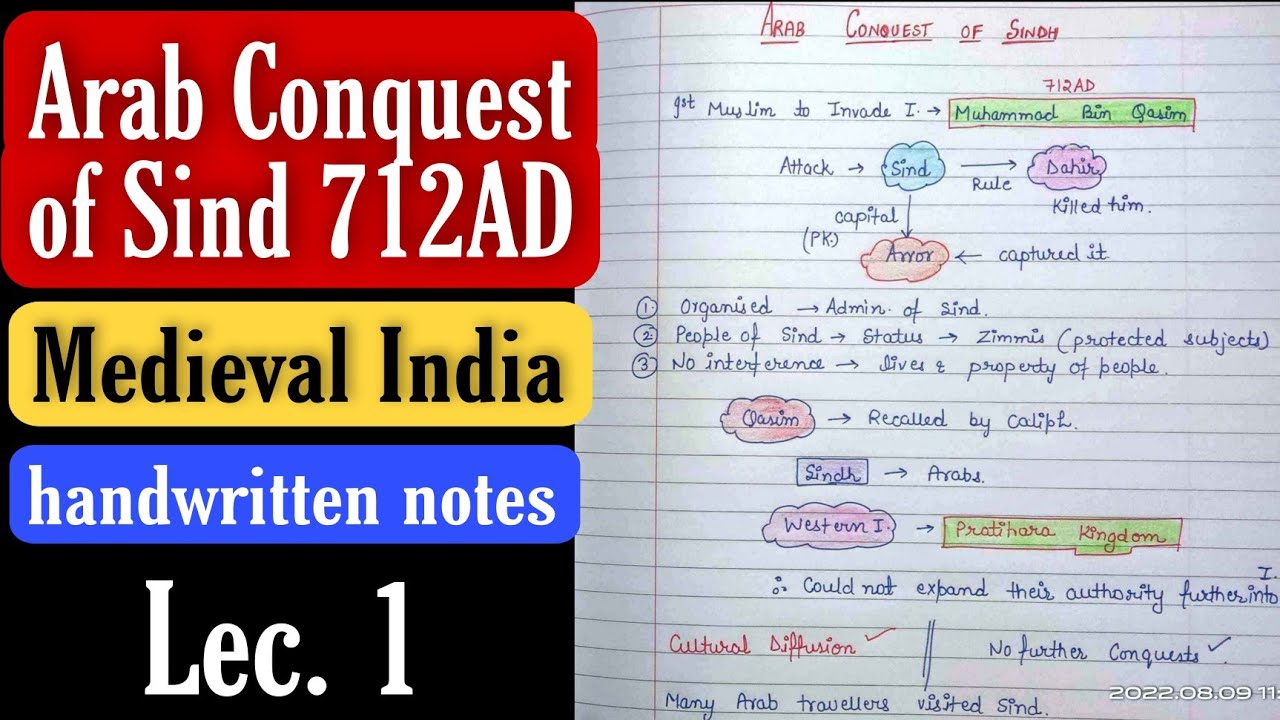
The Arab invasion of Sindh in 712 A.D., spearheaded by Muhammad-bin-Qasim, marks a pivotal, though initially localized, commencement of Muslim incursions into India. This historic event was fueled by deeply ingrained economic motives, a religious zeal for the spread of Islam, and a calculated quest for political expansion. For students analyzing early medieval transitions, this campaign offers critical insights into the fragmented Indian political landscape, uncovering how a local flashpoint laid the long-term foundations for the later Ghaznavid and Ghorid empires.
In this chapter, you will understand:
- The direct triggers and strategic goals behind the Arab invasion of Sindh in 712 A.D.
- The military expeditions of Muhammad-bin-Qasim and the defensive stand of King Dahir.
- The geopolitical transitions marking the expansion lines of Mahmud of Ghazni and Muhammad Ghori.
- The long-term commercial, administrative, and cultural exchanges established between India and the Arab world.
Why this topic matters: Analyzing the arrival of Arab forces in the Indus Valley explains how the strategic dynamics of the northwestern frontier permanently shifted, serving as the first milestone of Islamic military expansion deep into the Indian subcontinent.
Core Idea: Led by the youthful general Muhammad-bin-Qasim, the Arab army successfully penetrated the defenses of Sindh. While the political impact of this specific campaign remained geographically confined to the Indus basin, it opened up profound channels of communication and trade. Centuries later, more expansive, permanent Islamic empires were systematically built across India by northern conquerors like the Ghaznavids and Ghorids.
Early Muslim Incursions
In the broader narrative of Indian history, the conquest of Sindh signaled a major geopolitical breakthrough. Led by the youthful general Muhammad-bin-Qasim, the Arab army successfully penetrated the defenses of the region. However, despite its tactical brilliance, the long-term political impact of this specific campaign remained geographically confined to the Indus basin, acting more as a localized domain than an absolute immediate takeover of mid-continental India.
Geographical Limits & Cultural Exchange
The early parameters of Arab rule held a unique position. While it failed to instantly replace the larger political maps of northern India, it opened up profound channels of communication.
Dr. Ishwari Prasad's View
The operational limits of this campaign meant that Arab dominance remained a regional reality rather than a sweeping imperial transformation. Renowned historian Dr. Ishwari Prasad beautifully frames this entire historical episode as a "romance of history," celebrating the brilliant dash, immense heroism, and ultimate tragic, abrupt fall of Muhammad-bin-Qasim. Yet, beneath the military drama lay a highly functional consequence: it established deep commercial ties and unmatched cultural exchange between the Arab world and India.
- (i) The campaign was a limited success, geographically confining Arab rule to a small area of the Indus Valley.
- (ii) Despite limited political permanence, the invasion served as a crucial cultural and economic link.
Prominent Conquerors
While the initial Arab presence in Sindh remained a contained phenomenon, it acted as an institutional herald. Centuries later, more expansive, permanent Islamic empires were systematically built across India by formidable northern conquerors.
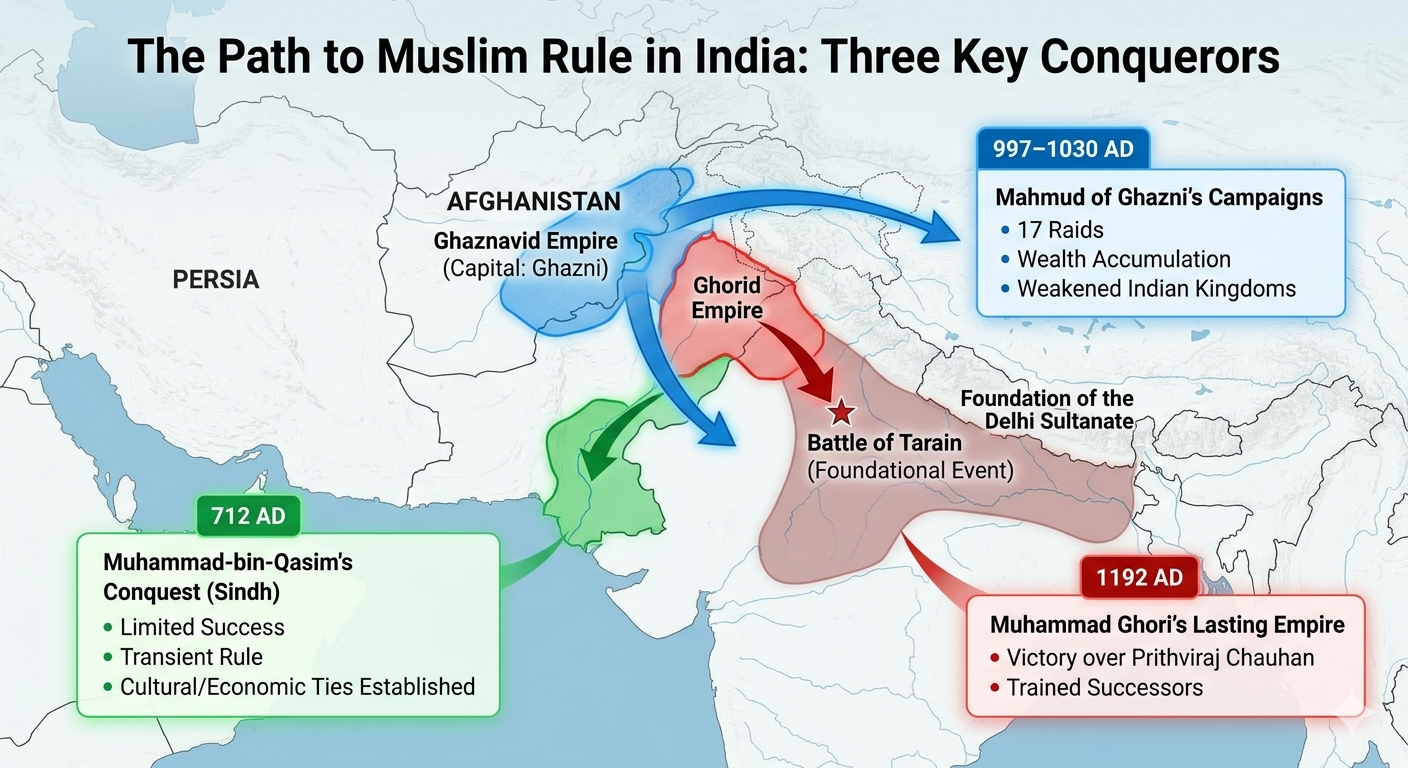
- The Forerunners of Lasting Muslim Rule: The transition from regional occupations to sprawling central empires was defined by distinct military operational doctrines.
Mahmud of Ghazni: The Ghaznavid Empire and Military Expansion (997–1030 A.D.)
Dominating the northwestern borders from 997 A.D. to 1030 A.D., Mahmud of Ghazni engineered a relentless series of campaigns. His primary objective centered on massive imperial expansion in Eastern Iran alongside striking seventeen raids into northern India to accumulate unmatched riches and weaken local rulers under the strategic flag of defending Islam. This wealth allowed him to convert his capital, Ghazni, into a legendary center of global power and culture.
Muhammad Ghori: Establishing the Muslim Empire in India
The arrival of Sultan Shahab-ud-din Muhammad Ghori reshaped Indian destiny. Unlike his predecessors, Ghori focused heavily on territorial consolidation. His enduring legacy rests on his meticulous approach to training competent successors and slave generals. Following his assassination, these trusted generals took up the administrative mandate, leading directly to the rise of the historic Delhi Sultanate after his monumental triumph at the Second Battle of Tarain in 1192 A.D.
Root Causes of the Arab Invasion
The flashpoint of 711–712 A.D. was not an isolated frontier skirmish. It was the natural outcome of multiple long-term ideological, financial, and political objectives colliding at the edge of the subcontinent.
- The Strategic Environment: Multiple dynamic forces interacted to drive the Caliphate's systematic expansion policy toward the frontiers of India.
Key Drivers of Conquest: Political, Economic, and Religious Aims
The Caliphate’s eastward gaze was steady and systematic, driven by a highly calculated expansionist doctrine following the passing of the Prophet.
- (i) Political Expansion: Following the rapid consolidation of Persia and Herat, the wealthy plains of India became the next logical target for the Caliphate's ongoing aggressive expansion policy.
- (ii) Spread of Islam: With western horizons secured, a powerful religious zeal directed the mission toward the massive, uncharted populations of the East.
- (iii) Economic Motives: Long-standing maritime trade had made Arab merchants deeply aware of India's immense wealth, transforming the conquest into an alluring plan for securing trade routes and looting riches.
The Immediate Trigger and Conflict with King Dahir
The structural motivations found their explosive catalyst at sea, where a single incident of piracy created an unresolvable diplomatic deadlock.

The Strategic and Immediate Causes of the Arab Invasion (711 AD) - (i) Plundering near Debal: Sea pirates operating near the port of Debal plundered ships bearing rare gifts and the orphan daughters of Muslim merchants traveling from the King of Ceylon to Hajaj, the powerful Viceroy of Iraq.
- (ii) Dahir's Defiance: When Hajaj demanded complete compensation and the immediate release of the captives, King Dahir declined to act, claiming he held zero functional authority over those specific sea pirates.
- (iii) The Casus Belli: This response was treated as an open, insolent challenge, giving the Viceroy the perfect political justification to secure the Khalifa’s official sanction for a full-scale punitive invasion.
Quick Revision Capsule
A structured breakdown of the primary operational waves, campaigns, and key geopolitical shifts during the early medieval campaigns:
| Campaign / Ruler | Core Strategy & Mechanism | Primary Target & Geopolitical Metric |
|---|---|---|
| Arab Invasion (712 A.D.) | Punitive expedition combining maritime assets, heavy siege craft, and targeted cavalry maneuvers. | Capture of the port of Debal, annexation of Sindh, and stabilization of regional trade routes. |
| Ubaidullah & Budail Waves | Frontier incursions launched to extract immediate reparations following diplomatic defiance. | Defeated and completely routed by King Dahir's local defensive lines. |
| Muhammad-bin-Qasim | Calculated, systematic tactical advance combining advanced weaponry and local alliances. | Overthrew King Dahir, conquered Sindh and Multan, establishing the first localized Muslim domain. |
| Mahmud of Ghazni (997–1030 A.D.) | Fast, high-impact cavalry actions executing seventeen devastating raids into northern plains. | Accumulation of massive wealth to enrich the capital city of Ghazni and weaken local kingdoms. |
| Muhammad Ghori (1192 A.D.) | Territorial consolidation through institutional training of successors and slave generals. | Decisive victory at the Second Battle of Tarain, laying the structural foundations for the Delhi Sultanate. |
Summary
The Arab invasion of Sindh (712 A.D.) stands as a definitive watershed moment in continental geopolitics. While its immediate administrative boundary remained local, it completely shattered the isolation of the western frontier, opening up the subcontinent to enduring outside influences. For students tracing these historical timelines, analyzing the friction between King Dahir and Hajaj is vital to understanding the step-by-step transition of medieval India toward a long, transformative era of Muslim rule.
Quick Revision Points for Students
Reviewing these core empirical and historical facts ensures full retention for competitive examinations.
- (i) The Arab invasion of Sindh occurred in 712 A.D., led by the Umayyad general Muhammad-bin-Qasim.
- (ii) The direct catalyst for war was the plundering of Arab ships by pirates near the port of Debal and King Dahir's refusal to offer compensation.
- (iii) Before Qasim's success, the Caliphate launched two failed expeditions under commanders Ubaidullah and Budail, both of whom were killed.
- (iv) Historian Dr. Ishwari Prasad refers to this specific invasion as a "romance of history" due to its heroic nature and abrupt end.
- (v) Unlike the permanent empire later founded by Muhammad Ghori at the Second Battle of Tarain (1192 A.D.), the initial Arab conquest remained localized.
- Exam Tip: Pay close attention to the distinction between the strategic objectives of early invaders. Remember that while the Arab campaigns and Ghaznavid incursions focused on regional control and wealth extraction, it was Muhammad Ghori's campaigns that systematically aimed for permanent territorial rule in India.
Frequently Asked Questions (FAQ)
Q1: Who was the ruler of Sindh during the Arab invasion of 712 A.D.?
A1: The region was ruled by King Dahir, a monarch who died fighting Arab forces during the decisive stages of the campaign.Q2: What was the main difference between the invasions of Mahmud of Ghazni and Muhammad Ghori?
A2: Mahmud of Ghazni focused primarily on launching seventeen devastating raids to gather immense wealth and weaken local kingdoms. In contrast, Muhammad Ghori aimed for permanent political control, training successors to build a lasting empire that eventually became the Delhi Sultanate.Q3: Why did the first two Arab military expeditions against Sindh fail?
A3: The expeditions led by Ubaidullah and Budail failed because they underestimated the defensive capabilities of King Dahir’s army, which successfully cut off and defeated the incoming forces on the difficult terrain of the delta.