The military expeditions of Muhammad Ghori during the late 12th Century A.D. altered the course of Indian history forever. Unlike earlier raiders who focused mainly on accumulating wealth, Ghori arrived in the subcontinent with a clear, calculated plan to establish a permanent political system. This targeted movement directly challenged the existing order controlled by the fragmented Rajput kingdoms, transforming the political landscape of North India and laying down the initial administrative frameworks that eventually developed into the Delhi Sultanate.
In this chapter, you will understand:
- The strategic drivers, early campaigns, and territorial gains of Muhammad Ghori in North-Western India.
- The tactical shifts, battlefield decisions, and massive political outcomes of the First and Second Battles of Tarain.
- The military expansion led by imperial generals across the heartlands of Bihar, Bengal, and Kanauj.
- The historical assessment of Ghori as a constructive empire builder who organized a long-term administrative legacy.
Why this topic matters: This foundational phase explains how regional fragmentation left North India vulnerable to centralized military strategies, making it a critical area of study for understanding the evolution of medieval Indian governance, administrative systems, and state-building processes.
Core Idea:Muhammad Ghori’s campaigns represents a sharp shift from temporary plundering raids to deliberate, systemic imperial colonization. By leveraging coordinated military tactics and appointing permanent regional administrators like Qutub-ud-din Aibak, his victories decisively ended the absolute dominance of regional Rajput clans and fixed a new center of sovereign rule at Delhi.
Muhammad Ghori: The Rise of a Statesman and the Battles of Tarain (12th Century A.D.)
The arrival of Muhammad Ghori marks a defining transition in the history of the subcontinent. His actions moved away from the pattern of deep, destructive raiding toward a policy of steady territorial integration and sovereign control over conquered lands.
Motives, Early Conquests, and the Road to Tarain
Muhammad Ghori's expansionist push was driven by a practical mix of long-term political planning, resource acquisition, and imperial prestige. This strategy guided his early military actions toward controlling crucial entry routes along the north-western frontiers.
- (a) Reasons for Conquests: His key objectives centered on capturing the highly profitable networks of Punjab and Multan, proving his absolute military superiority, extending the ideological reach of Islam, and securing continuous resources to build a permanent, stable territorial headquarters inside India.
- (b) Key Early Conquests: He successfully brought Multan and Uch under his influence during the late 11th century A.D. and completely secured Sindh by 1182 A.D. Even though he encountered a severe early defeat against Bhima II, the Vaghela ruler of Gujarat, at the battle of Anhilwara, he adapted his strategy efficiently. By 1186 A.D., he entirely occupied the strategic border positions of Lahore and the wider Punjab region.
- (c) First Battle of Tarain (1191 A.D.): This expansion led to a major clash near Thaneswar, where Ghori encountered the massive allied Rajput forces commanded by Prithviraj Chauhan, the ruler of Delhi and Ajmer. The initial encounter resulted in a complete victory for Prithviraj Chauhan, which broke the imperial lines and forced a costly, difficult retreat for Muhammad Ghori back to Ghazni.
The Second Battle of Tarain and the Foundation of Muslim Rule
The subsequent military response organized in 1192 A.D. stood out as an explicitly calculated campaign of conquest. The outcome of this singular engagement dissolved the defensive coalition built by the northern kingdoms and restructured the regional balance of power.
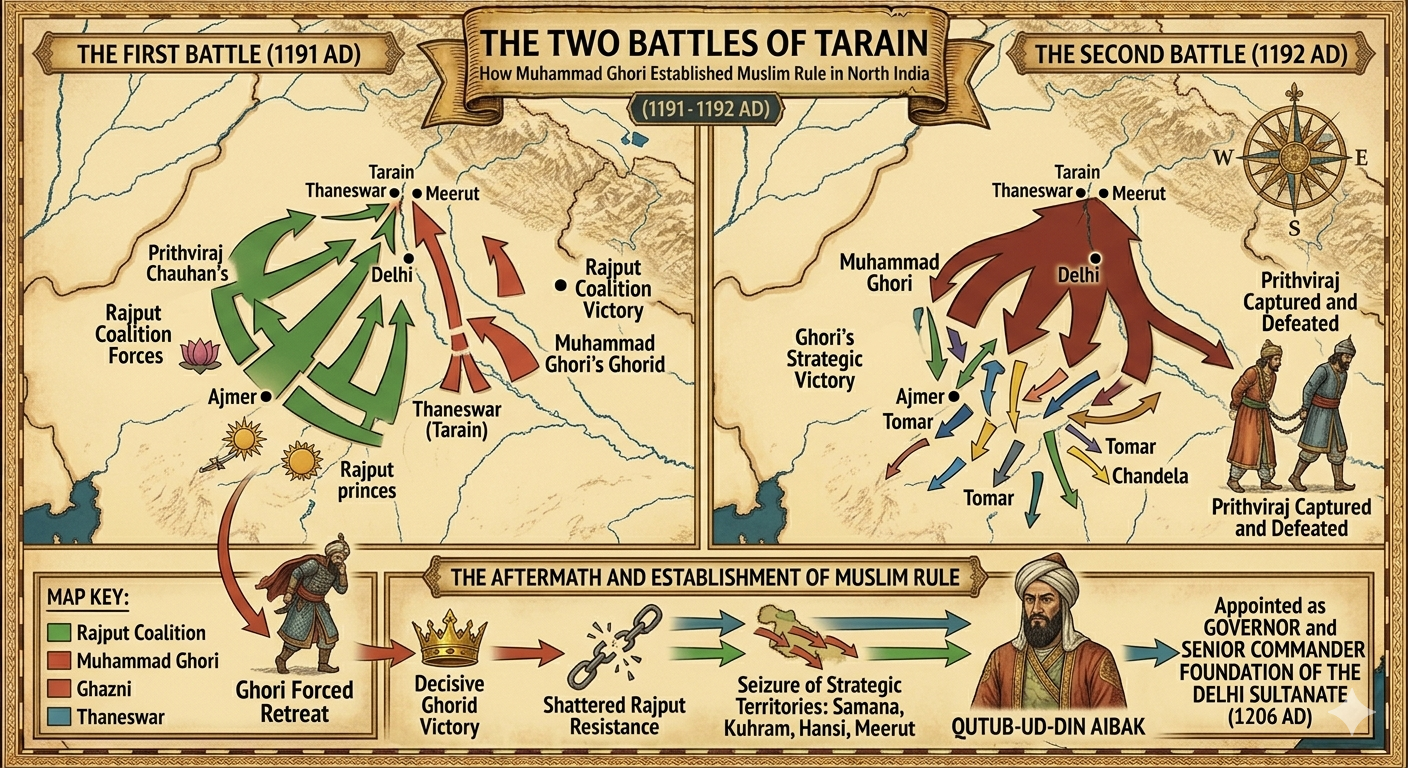
- The victory shattered the core military alliance of North India, removing the immediate checks to external imperial consolidation.
The Tactical Reversal and Administrative Planning
The second major encounter at Tarain showcased advanced battlefield tactics, where flexible cavalry movements outmaneuvered traditional defensive setups.
- (i) Second Battle of Tarain (1192 A.D.):Muhammad Ghori returned to the field with a large, systematically organized force. Although Prithviraj Chauhan assembled a massive defensive front supported by nearly 150 Rajput princes, Ghori's specialized horse-archer maneuvers effectively exhausted the opposing lines, resulting in a absolute victory and the capture of Prithviraj.
- (ii) Seizure of Strategic Territories: This key victory crushed organized regional opposition, enabling Ghori to immediately occupy vital defensive points including Samana, Kuhram, and Hansi, which locked down his strategic control over North India.
- (iii) Appointment of Successor: To secure these gains, Muhammad Ghori appointed his most capable general, Qutub-ud-din Aibak, to run his territorial acquisitions, choosing steady regional administration over rapid pillaging and clearing the way for the emergence of the Delhi Sultanate.
Muhammad Ghori's Later Conquests, Expansion, and Enduring Legacy
Following the success at Tarain, Ghori's primary commanders rapidly extended the imperial borders across the fertile plains of Hindustan, bringing major economic and cultural centers under centralized administrative management.
- The systematic push eastward effectively connected the trade networks of the Indus valley with the rich agricultural production of the lower Ganges.
The Battle of Kanauj and Rapid Eastern Expansion
The rapid expansion continued through targeted campaigns against the Gahadvala kingdom, followed by deep eastern sweeps managed by the aggressive general Ikhtiyar-ud-din Muhammad-bin-Bakhtiyar Khalji.
- (a) Battle of Kanauj (1194 A.D.):Muhammad Ghori encountered, defeated, and killed Jaichandra, the Gahadvala King, at the notable Battle of Chandwara. This victory opened up immediate access to the wealthy political and religious hubs of Kanauj and Banaras, an important historical milestone validated by scholar S.R. Sharma.
- (b) Invasion of Bihar:Ikhtiyar-ud-din Khalji executed a highly destructive advance through Bihar, capturing fortified locations and causing the systematic destruction of key monastic centers, which uprooted ancient Buddhist and Hindu monk networks.
- (c) Conquest of Bengal (1204-05 A.D.): Following up on his momentum, Ikhtiyar-ud-din mounted a surprise cavalry raid against Nadia, the royal seat of Bengal, causing the ruling monarch to retreat. This swift stroke placed Western Bengal firmly under Ghorid authority and brought massive regional treasuries under imperial command.
Quick Revision Capsule: Ghorid Campaigns & Imperial Milestones
A structured chronological breakdown of the core campaigns, strategic objectives, and long-term administrative transformations under Muhammad Ghori:
| Campaign & Date | Strategic Opponent / Region | Core Historical Outcome |
|---|---|---|
| Early Frontier Raids (Up to 1186 A.D.) | Multan, Sindh, and the Ghaznavid holdouts in Lahore | Secured crucial entry points and established a solid military base within Punjab. |
| First Battle of Tarain (1191 A.D.) | Prithviraj Chauhan & the allied Rajput Coalition | Tactical failure for Ghori near Thaneswar, forcing an absolute retreat to Ghazni. |
| Second Battle of Tarain (1192 A.D.) | Prithviraj Chauhan & 150 Rajput Princes | Decisive imperial victory that shattered regional coalitions and placed Delhi under central control. |
| Battle of Chandwara (1194 A.D.) | Jaichandra, the Gahadvala King | Secured the political heartlands of Kanauj and Banaras, extending authority over the middle Ganges plains. |
| Eastern Expansions (1204-1205 A.D.) | Nadia Capital / Regional Centers of Bihar & Bengal | Brought Western Bengal into the imperial fold under the direction of commander Ikhtiyar-ud-din Khalji. |
Summary
The historical interventions of Mahmud of Ghazni and Muhammad Ghori altogether represent a key transition point in the political evolution of medieval India. While the earlier phase under Mahmud was defined by fast, aggressive wealth-extraction that exposed the structural vulnerabilities of the northern kingdoms, Ghori operated as an actual empire architect. His victory at the Second Battle of Tarain against Prithviraj Chauhan laid down the actual foundations for the first enduring external dynastic state in the region, providing students with the historical baseline needed to trace the rise of the Delhi Sultanate and the emergence of institutional medieval Indian polity.
Key Revision Points & Core Directives
Students must track these central thematic elements during final review sessions:
- (i) Strategic Target Reorientation: Ghori modified the earlier model of quick looting into a process of territorial annexation and administrative stabilization.
- (ii) Tactical Innovations on the Field: The smart deployment of flexible, fast cavalry units at Tarain neutralized traditional defensive forces.
- (iii) Institutional Continuity Planning: The early delegation of power to trusted generals ensured stability, keeping the state intact even after Ghori's sudden assassination following the 1205 A.D. conflict with the Khokhars.
- (iv) Long-Term Political Restructuring: The fall of the Gahadvala and Chauhan dynasties permanently broken the defensive network of regional clans, moving the center of political gravity permanently toward Delhi.
- Exam Tip: Always contrast the economic focus of Mahmud of Ghazni with the institutional state-building approach of Muhammad Ghori. Focus closely on the administrative choices made after 1192 A.D., as the appointment of regional governors serves as the direct institutional preface to the founding of the Slave Dynasty in 1206 A.D.
Frequently Asked Questions (FAQ)
Q1: Why did Muhammad Ghori succeed in the Second Battle of Tarain after failing in the first?
A1: Ghori completely redesigned his battlefield tactics, bringing in highly mobile light cavalry archers to split up and tire out the compact, slower-moving lines of the Rajput defensive forces.Q2: What role did Qutub-ud-din Aibak play in Ghori's imperial system?
A2: He functioned as the principal resident administrator for Indian acquisitions, preserving local control over conquered lands and ensuring continuous revenue collection while Ghori handled military affairs across Central Asia.Q3: How did the Battle of Chandwara impact the regional power balance?
A3: The defeat of Jaichandra dissolved the powerful Gahadvala state, transferring complete control of the vital trade cities of Kanauj and Banaras over to the growing central administration.