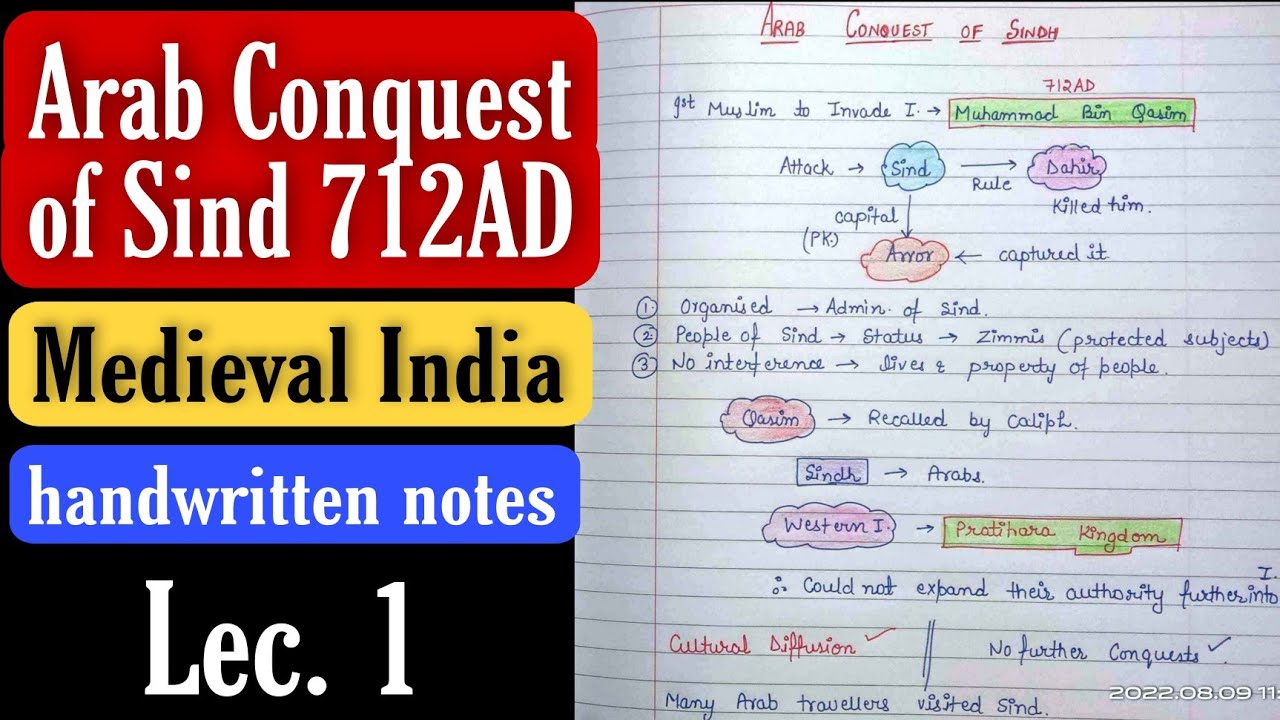
In 712 A.D., a pivotal turning point unfolded in the Indian subcontinent when the young and ambitious general, Muhammad-bin-Qasim, launched his historic military expedition into Sindh. Backed fully by the political power and resources of the Umayyad Caliphate, this strategic move marked the initial organized entry of Islamic armies into mainland India. The invasion targeted crucial trading hubs, wealthy cities, and strategic ocean ports along the Indus River valley, establishing a permanent geopolitical footprint in the region and shifting the trade and political alignments of classical India forever.
In this chapter, you will understand:
- The military structure, specialized units, and advanced artillery tech used during the initial invasion.
- The tactical steps, sieges, and battles that brought down major strongholds like Debal, Rawar, and Aror.
- The dramatic political downfalls, internal rivalries, and tragic ends of both King Dahir and general Muhammad-bin-Qasim.
- The permanent cultural, mathematical, and scientific exchange that introduced Indian texts to the Arab world.
Why this topic matters: This campaign serves as a critical historical blueprint showing how internal divisions, outdated military tactics, and localized thinking exposed ancient Indian kingdoms to fast-moving external forces.
Core Idea: Powered by Syrian cavalry and advanced military technology, Muhammad-bin-Qasim systematically captured Sindh and Multan. While local rivalries and non-violent political adjustments made early victories easy, fierce structural resistance from neighboring empires eventually isolated the region into independent Arab states. However, this interaction created a profound intellectual connection that channeled crucial Indian mathematics, medicine, and astronomy directly into Baghdad.
The Sindh Expedition and Military Strength
Muhammad-bin-Qasim commenced his campaign with a powerful, highly disciplined force carefully designed for long-range warfare across rough terrains. This army was heavily invested in by central rulers to ensure complete success over regional forces.
Cavalry Units and Transport Infrastructure
The core strike units depended on immense speed and tactical coordination to shock defenders before they could assemble unified regional defenses.
- (i) The initial force included a massive contingent of 6,000 Syrian horses, creating the fast-moving backbone of the mobile cavalry units.
- (ii) This core force was supported by an additional 6,000 cavalry drawn directly from the Caliphs' standing armies, highlighting the great state value placed on this mission.
- (iii) The immense logistical footprint required 3,000 Bactrian animals to transport supplies and massive heavy baggage units across challenging borderlands.
The Siege and Fall of Debal: A Strategic Victory (712 A.D.)
The first major urban target of the invasion was the fortified seaport of Debal, a vital naval and economic hub whose eventual fall set a harsh tone for the rest of the regional campaign.

- (i) Before passing the final borders, critical military technology and reinforcements were secured from the Governor of Makran to handle heavily fortified concrete walls.
- (ii) A massive boost in field firepower came from 5 catapults—heavy medieval artillery systems—each operated by 500 highly trained personnel, totaling 2,500 specialists.
Alliances and Arrival at the Fortress of Debal
The army arrived at the gates of Debal in the spring of 712 A.D. and immediately set up a strict siege. The local garrison was commanded by King Dahir’s nephew.
- Implementation elements showed deep domestic cracks: local tribes like the Jats and Meds, who felt oppressed by King Dahir, chose to ally themselves with the incoming army.
The Mystery of the Temple Flagstaff and the City's Surrender
The defense was initially firm because local Brahmanas placed a sacred talisman on a large red flag flying atop the central temple, making the population believe the city was safe from any collapse.
- A local Brahman leaked this vital secret to the Arab army, explaining that destroying the flag would break the psychological spirit of the defenders. Qasim used his heavy catapults to target and destroy the flagstaff, triggering a swift collapse of local morale and leading to immediate surrender.
Massacre, Booty, and Religious Transformation in Debal
Once inside, the commander ordered a brutal three-day massacre of the city's inhabitants. The surviving populations were forced to convert to Islam or face death or severe enslavement.
- The capture yielded extensive booty, including 700 beautiful females sent back to Hajaj or shared among the ranks as spoils. Temples were systematically demolished to build mosques, and the public Khutbah sermon was officially introduced to mark the new state authority.
Non-Violent Conquest of Nerun and Sehwan
After the bloody actions at Debal, the army pushed inland, experiencing a mix of diplomatic surrenders and weak defensive stands that accelerated their campaign momentum.

- The army marched steadily from Debal deeper along the Indus waterways towards targeted settlement centers.
Nerun: Surrender by Buddhist Priests
The city of Nerun was populated and led largely by Buddhist priests and Sramanas who strongly followed principles of non-violence.
- Adhering to their beliefs, these leaders chose to surrender the gates without launching a military counter-offensive, giving the Arab forces an effortless, peaceful victory.
Sehwan: Weak Resistance and the City's Fall
Moving forward, the army advanced on Sehwan, a city governed by Bajhra, a cousin of King Dahir.
- The resistance put up by Bajhra's local units was disorganized and weak. The defense quickly cracked under pressure, causing Bajhra to flee and leaving Sehwan to fall into Qasim's control.
The Pivotal Battle with King Dahir at Rawar
The main military clash of the entire campaign occurred when the Arab forces met the complete royal army commanded directly by King Dahir on the open field.

Crossing the Indus and Dahir’s Strategic Retreat
To confront the royal core, Qasim had to cross the massive, fast-flowing Indus River under defensive eyes.
- (i) The general built a tactical bridge of boats, crossing his units quickly across the water before the enemy could properly react.
- (ii) Surprised by this rapid movement, King Dahir pulled back his outer defensive outposts to set up a final, deep stand at Rawar.
The Decisive Clash, Defeat, and Death of King Dahir
The battle at Rawar was intensely violent, with the local armies deploying massive war elephants to break up the incoming lines.
- During the intense action, an arrow startled Dahir’s war elephant, causing it to bolt blindly into the Indus River. Though the king quickly switched to a horse to rally his breaking lines, the sudden absence of his standard on the elephant caused massive panic, causing his forces to break and leading to his death on the field.
Rani Bai’s Defense and the Act of Jauhar
Resistance continued even after the king fell. His widow, Rani Bai, took command of the leftover garrison of 15,000 soldiers inside the fort walls.
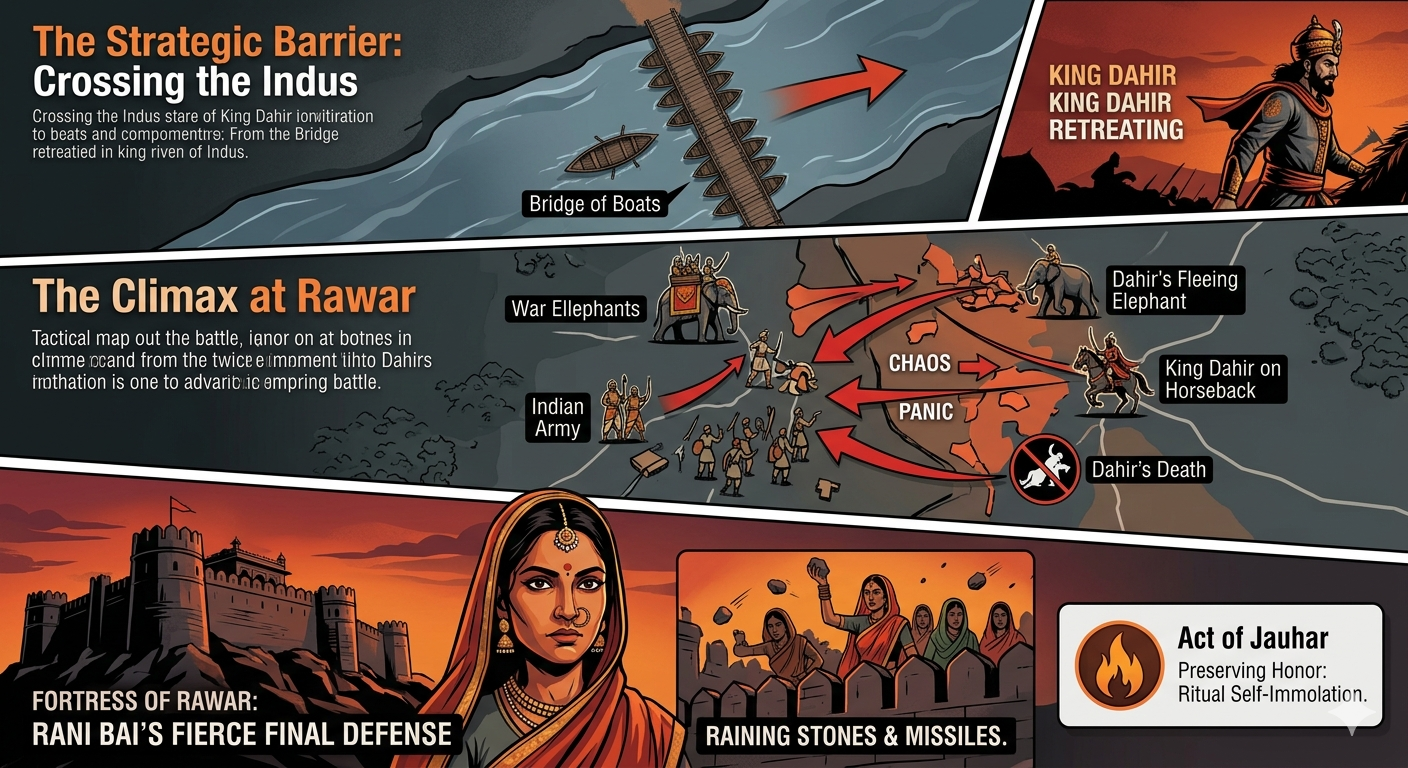
The Battle of Rawar: King Dahir and the Jauhar of Rani Bai - Defenders rained stones and heavy arrows down on the attackers. Realizing that defeat was inevitable, Rani Bai and the women of the city performed Jauhar—sacred self-immolation—to defend their honor.
Campaign Milestone Quick Revision Capsule
A structured timeline checklist covering the core military steps, key outcomes, and historical leaders involved during the Arab invasion:
| Campaign Location | Key Historical Leaders Involved | Primary Strategy & Core Outcome |
|---|---|---|
| Debal (712 A.D.) | Muhammad-bin-Qasim vs. Nephew of King Dahir | Used heavy catapults to destroy the sacred temple flag, leading to a three-day massacre and capture of the port. |
| Nerun | Buddhist Priests & Sramanas | Peaceful surrender based on non-violent religious beliefs, opening an easy pathway deeper inland. |
| Sehwan | Bajhra (Cousin of King Dahir) | Weak, uncoordinated defenses collapsed quickly, leading to an easy occupation by Arab units. |
| Rawar | King Dahir & Rani Bai | Decisive field battle; Dahir's elephant panicked, leading to his death and the mass performance of Jauhar. |
| Brahmanabad & Aror | Jai Singh (Son of Dahir) & Rani Ladi | Fierce resistance causing 8,000 casualties; Dahir's daughters captured, completing the conquest of Sindh. |
Summary
The military conquest of Sindh concluded with the systematic capture of the royal capital at Aror and the northern trading hub of Multan. At Brahmanabad, Dahir's son Jai Singh fought fiercely, losing 8,000 men before pulling back, which led to the capture of Rani Ladi and Dahir's daughters, Surya Devi and Parmal Devi. The capture of Multan followed an extended siege, broken only when a local traitor cut off the city's central water supply. The vast amounts of gold discovered there earned it the title "City of Gold." Flush with wealth, Qasim dispatched 10,000 horses under Abu Hakim to capture Kanauj, but political intrigue cut his career short.
Key Historical Debates Regarding Demise
Two conflicting historical narratives outline the abrupt execution of the general:
- (i)The Daughters' Revenge:Surya Devi and Parmal Devi falsely informed the Khalifa that Qasim had violated them before sending them as gifts, prompting an immediate order to sew Qasim alive into a raw ox hide.
- (ii)The Ox-Hide Execution: Qasim blindly obeyed, dying during transit. When the daughters confessed it was an act of revenge for their kingdom, the furious ruler had them dragged to death by horses.
- (iii)Court Conspiracy Theory: Political analysts suggest Qasim fell victim to a purge targeting his father-in-law Hajaj, with rivals turning the state against him.
- Exam Tip: Pay close attention to the scientific and administrative effects of the conquest. Historian Lane Poole's classic quote calling the invasion a "mere episode in the history of India and Islam, a triumph without result" is a frequent focal point in evaluations of this era.
Frequently Asked Questions (FAQ)
Q1: Why did the political control of the Arabs fail to expand beyond Sindh and Multan?
A1: Strong military resistance from the Rajput rulers of Northern and Eastern India formed an effective wall against further expansion. Additionally, regional Indian rulers viewed the fall of Sindh as a local tragedy rather than an overall threat.Q2: How did the Abbasid Revolution of 750 A.D. alter the administration of Sindh?
A2: The revolution overthrew the Umayyads and severely weakened central control. By 781 A.D., the central authority vanished completely, splitting the region into two independent Arab kingdoms based in Mansurah and Multan.Q3: What was the nature of the cultural and scientific exchange after the conquest?
A3: The exchange was rich and long-lasting. Fundamental texts like the Brahma Siddhanta and Khanda Khadyaka were translated into Arabic under rulers like Harun-ul-Rashid, introducing Indian numerals and medical knowledge to the Arab world and later to Europe.