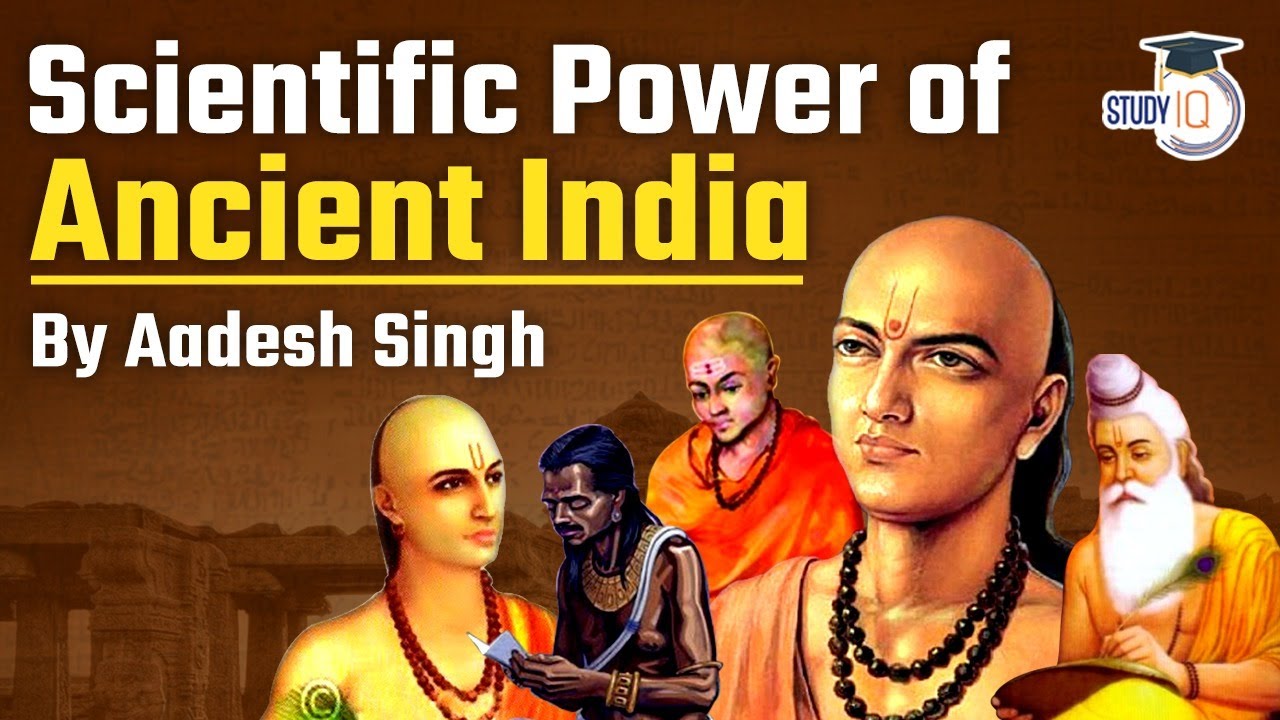
The Ancient Indian Civilization was a vibrant era marked by the deep blending of religion, philosophy, science, society, and politics. This period saw the foundation and rise of world belief systems, including Hinduism, Buddhism, and Jainism, alongside long-lasting inventions in mathematics (such as zero), astronomy, medicine (Ayurveda), art, and literature. For students preparing for competitive exams, understanding these connected achievements gives essential context into how thought, governance, technology, and culture evolved in ancient India and went on to influence global knowledge across history.
In this chapter, you will understand:
- The religious and philosophical foundations of ancient Indian society.
- Artistic expression, metallurgy, and technological achievements like Wootz steel.
- The evolution of governance, statecraft, and Ashoka's ethical edicts.
- Groundbreaking contributions in mathematics, astronomy, and holistic medicine.
Why this topic matters: It covers core historical concepts frequently asked in competitive exams regarding ancient Indian polity, philosophy, social structures, and scientific contributions.
Core Idea: Ancient India established integrated frameworks of ethical conduct, analytical philosophy, advanced metallurgy, and decimal mathematics. These developments provided internal socio-political stability while permanently altering the global landscape of science, medical practice, and statecraft.
Ancient Indian Civilization: The Synthesis of Religion, Profound Thought, Advanced Science, Art, and Enduring Global Contributions (c. 3000 BCE – 500 CE)
Religion and philosophical reflection formed the backbone of ancient Indian life, shaping daily ethical standards, state policies, and academic research. This civilization built lasting frameworks for spiritual life, structured social systems, and systematic scientific inquiry that spread across Asia, the Middle East, and beyond.
Religious Foundations and The Shaping of Social Frameworks in Ancient India
Religious belief stood as a primary driving force in ancient Indian life. It directly guided politics, classical literature, grand architecture, and personal duty, giving rise to a structured societal organization.
- (i) Structuring Moral Life: The concept of dharma (righteous conduct) was fundamental, organizing societal duties through codified frameworks like varna (social classes) and jati (sub-castes).
- (ii) Nurturing Diverse Thought: Intellectual curiosity thrived, producing diverse systems of thought such as Samkhya (systematic enumeration), Nyaya (logical analysis), and Vedanta (philosophical conclusion of the Vedas).
- (iii)
Role of Religion in Society and State Governance
The emergence of indigenous religious traditions transformed state administration, holding rulers and citizens accountable to ethical guidelines for social balance.
- (a) Rise of Major Faiths: The growth of Hinduism, Buddhism, and Jainism offered distinct ethical models that rulers integrated into law and administration.
- (b) Dharma and Identity: The Varna and Jati systems assigned specific social obligations (dharma), traditional occupations, and community identities.
- (c) Stability and Social Cost: Although these arrangements brought predictable stability over generations, they introduced layers of rigidity, social stratification, and inequality into the community.
Philosophical Exploration and Intellectual Diversity: The Seeds of Rational Inquiry
Ancient Indian philosophy blended rational inquiry into nature with spiritual discipline aimed at achieving ultimate liberation (moksha).

Primary Orthodox Schools of Thought: Logic and Metaphysics
Formal schools of thought developed systematic methods to analyze reality, logic, and self-realization.
- (i) Samkhya: This school focused on analytical knowledge of reality's constituent elements (tattvas) as the path to free the spirit from suffering.
- (ii) Nyaya: Centered on rigorous logic and epistemology, Nyaya established strict conditions for verifying valid knowledge (pramana).
- (iii) Vedanta: As the culmination of Vedic reflection, Vedanta examined the non-dual ultimate reality (Brahman), influencing later Hindu philosophy.
- (iv)
Pioneering Philosophers and Their Core Contributions
Thinkers presented radical perspectives, ranging from step-by-step spiritual liberation to complete philosophical materialism.
- [1] Kapila: Credited with founding Samkhya, Kapila highlighted analytical discrimination (viveka) as essential for spiritual freedom.
- [2] Charvaka: This school advanced the materialistic philosophy (Lokayata), holding direct sensory perception as the only valid knowledge source while rejecting supernatural claims.
- [3] Shaping Broader Traditions: The Upanishads, teachings of Siddhartha Gautama (the Buddha), and Mahavira (Jainism) reshaped regional intellectual traditions.
Artistic Expression and Technological Mastery: From Wootz Steel to Temple Art
Art, crafts, and metallurgy in ancient India combined aesthetic craft with industrial skill, generating high international demand for Indian trade products.
Advanced Craftsmanship and Revolutionary Metallurgy
Indian craftsmen excelled in working with metals, achieving advanced chemical purity and high durability that stood unmatched for centuries.
- (i) Wootz Steel Invention: The development of wootz steel (the source of Damascus steel) gained global fame for its high tensile strength and sharpness.
- (ii) Refinement in Arts: Specialized techniques in textile dyeing, gemstone cutting, and fine pottery reached technical excellence.
- (iii) Trade Boost: Advances in ironworking (such as the rust-resistant Delhi Iron Pillar) and textile exports enriched trade networks linking Rome, South Asia, and China.
- (iv)
Sophisticated Artistic Expressions: Murals and Sacred Sculpture
Visual art communicated religious ideas and civic history through enduring stone and pigment works.
Frescoes and wall paintings inside the Ajanta Cave complex - Ajanta-Ellora Murals: The Ajanta-Ellora murals in Maharashtra remain iconic examples of ancient painting, depicting Buddhist narrative motifs and courtly scenes.
- Temple Sculpture: Detailed stone reliefs decorated structural temples, portraying Hindu, Buddhist, and Jain iconographies.
- Integration of Craft: Practical items blended daily utility with spiritual motifs, embedding artistic standards into common items.
Political Structures and the Paradigm of Ethical Governance (Mauryan and Post-Mauryan Era)
Indian political systems evolved over time, shifting from early tribal councils and autonomous republics (ganasanghas) to centralized empires with administrative networks.
Ashoka’s Transformation: Statecraft Guided by Buddhist Ethics
Emperor Ashoka altered imperial governance by shifting the focus of imperial rule from military expansion to administrative ethics and public care.
- (i) Integration of Principles: Following the Kalinga War, Ashoka the Great incorporated Buddhist ethical principles (Dhamma) directly into state administrative policy.
- (ii) The Edicts: Inscriptions carved into rock surfaces and polished stone pillars promoted non-violence (Ahimsa), religious tolerance, and public welfare projects.
- (iii) Ethical Justice: His administration appointed specific officials (Dhamma Mahamattas) to oversee ethical administration and public welfare.
- (iv)
The Broader Political Evolution: Assemblies, Empires, and Diplomacy
Regional administrative setups balanced local village governance with large imperial treasuries and armies.
- [1] Democratic Tendencies: Local assemblies (Sabhas and Samitis) functioned as participatory bodies for resolving community issues.
- [2] Imperial Administration: Empires like the Mauryas and Guptas established multi-tiered bureaucratic systems to collect revenue, maintain security, and manage public infrastructure.
- [3] External Enrichment: Diplomatic contacts, including Greek diplomatic exchanges following Alexander’s campaigns, influenced local coin design, diplomacy, and Gandhara art.
Scientific Knowledge and Rational Inquiry: Astronomy, Medicine, and Linguistics
Scientific studies in ancient India relied on systematic observation, leading to practical progress in astronomical tracking, medical procedures, and linguistic grammar.
Pioneering Astronomy and its Role in Agriculture
Observational astronomy supported practical needs such as setting crop calendars, tracking seasons, and keeping accurate time.
- (i) Timekeeping Guidance:Celestial calculations (such as those recorded by Aryabhata) established solar-lunar calendars, tracked planetary motion, and calculated eclipses.
- (ii) Agricultural Planning: Precise seasonal tracking gave farmers reliable data to schedule planting and harvest cycles.
- (iii) Integration with Rituals: Calendar accuracy helped fix auspicious times (muhurtas) for civic events and ceremonies.
- (iv)
Revolutionary Medical Science: Ayurveda and Surgical Techniques
Medical tradition combined clinical observation, surgical methods, and plant remedies to maintain health and treat disease.
- [1] Advanced Practice: Ancient surgeons performed complex procedures, including plastic surgery and cataract removals, as documented in classical texts like the Sushruta Samhita.
- [2] Ayurveda's Holistic Approach: The clinical system of Ayurveda focused on balancing bodily humors (Vata, Pitta, Kapha) through diet, medicines, and lifestyle adjustments.
- [3] Knowledge Transmission: Medical treatises were translated into foreign languages, spreading medical techniques into Central Asia, the Middle East, and Southeast Asia.
Mathematical Innovations and Their Global-Scale Impact on Computation
Mathematical discoveries made in ancient India simplified arithmetic calculations and formed the basis for modern mathematical science.
The Invention of Zero and the Decimal Place-Value System
Developing zero as an active numeral alongside positional place value changed computational math permanently.
- (i) Zero and Place-Value: Using zero as both a distinct numerical quantity and a positional placeholder enabled the decimal place-value system.
- (ii) Enabling Complex Math: This setup simplified calculation methods, opening doors for advanced algebra, trigonometry, and planetary calculations.
- (iii) Global Adoption: Scholars in the Islamic world studied these methods, referring to them as Hindu numerals, before introducing them to Europe.
- (iv)
Pioneers in Mathematics: Aryabhata and the Rules of Computation
Scholars expanded mathematical theory through foundational treatises and operational rules.
- [a] Aryabhata: Author of the Aryabhatiya in , Aryabhata calculated pi (π) to four decimal places, introduced sine tables, and explained that the Earth rotates on its axis.
- [b] Brahmagupta: In his writings, Brahmagupta established operational rules for calculating with positive numbers, negative numbers, and zero.
- [c] Shaping Computation: These mathematical frameworks laid the foundation for modern global calculation, geometry, and space observations.
Quick Revision Capsule
Key summary of core achievements and fields during the Ancient Indian period:
| Field / Domain | Key Inventions & Concepts | Global Impact & Significance |
|---|---|---|
| Mathematics | Invention of Zero, Decimal Place-Value System, Sine tables | Transformed global arithmetic, computation, and modern algebra. |
| Medical Science | Ayurveda, Sushruta's surgical methods, herbal pharmacology | Pioneered holistic medicine and early surgical techniques globally. |
| Metallurgy | Wootz Steel production, corrosion-resistant iron pillars | Set early international benchmarks for high-tensile steel and trade. |
| Philosophy | Samkhya, Nyaya, Vedanta, Charvaka, Buddhist & Jain thought | Established systematic logic, epistemology, and metaphysical frameworks. |
| Governance | Ashoka's Edicts, Dhamma, village assemblies (Sabhas/Samitis) | Introduced moral ethics, non-violence, and welfare into monarchical statecraft. |
Summary
The Ancient Indian Civilization combined religion, philosophy, science, statecraft, and art into an integrated culture over thousands of years. Its major innovations—such as the decimal system, Ayurveda, Wootz steel, astronomical models, and epic literary works like the Ramayana and Mahabharata—shaped local life while contributing significantly to world trade and knowledge. For students preparing for competitive examinations, studying this era highlights India's historic role as an early center for intellectual inquiry, ethical administration, and scientific discovery.
Quick Revision Notes
Essential facts to review before examinations:
- (i) The decimal place-value system and zero were invented in India and spread globally via Arab scholars.
- (ii) Charvaka represents the materialist (Lokayata) school that accepted sensory perception as the only valid knowledge source.
- (iii) Emperor Ashoka used public edicts carved on rocks and pillars to communicate state moral policies (Dhamma).
- (iv) Sushruta is recognized for early surgical procedures, while Aryabhata worked on pi, sine tables, and Earth's rotation in .
- Exam Tip: Pay close attention to the differences between orthodox (Astika - Samkhya, Nyaya, Vedanta) and heterodox (Nastika - Buddhism, Jainism, Charvaka) philosophical schools. Questions frequently test their core texts, founders, and views on valid sources of knowledge (pramana).
Frequently Asked Questions (FAQ)
Q1: What is the historical importance of the invention of zero in ancient India?
A1: Zero allowed numbers to be written using position rather than separate symbols for every large quantity. This base-10 system simplified computational calculations and became the foundation for modern global mathematics.Q2: How did Ashoka’s concept of Dhamma differ from religious doctrine?
A2: Ashoka’s Dhamma focused on civic ethics and public conduct—such as non-violence, tolerance among sects, respect for elders, and social welfare—rather than promoting specific religious rituals or theological doctrines.Q3: What were the major achievements of ancient Indian metallurgy?
A3: Ancient Indian metallurgists developed Wootz steel, highly valued internationally for sword-making, and built corrosion-resistant iron structures like the Delhi Iron Pillar.